Real Assets Command Attention in Today’s Investment Climate
A private equity allocator who looked at portfolio performance at the beginning of 2026 would have spotted an unsettling situation. The cash flows which had been priced a year before no longer extended as they used to, and the fixed income positions intended to provide stability were gradually losing ground in real terms. This situation has occurred in boardrooms all over the country during the year. U.S. inflation reached 3.8 percent in April 2026, the highest level since March 2023, a result largely due to disruptions in the energy markets, as stated in CBRE Investment Management’s Infrastructure Quarterly: Q2 2026 report.
Since prices remain volatile, investors have had to reconsider how portfolios are constructed. Bonds perform poorly when prices rise suddenly. Public equities do provide a certain level of protection, but they remain at risk from margin compression. Inflation hedging has therefore changed from being a minor issue to becoming a main aim for those who manage multi-decade liabilities and allocate funds in private markets. This has led to greater interest in real assets, physical holdings such as property, infrastructure, and natural resources, that often generate income moving in line with prices. At the same time, another kind of change is taking place. Emerging tokenization technologies are expanding investor access to traditionally illiquid real assets. Real assets have historically provided different forms of inflation protection, while emerging technology is changing how investors access these traditionally illiquid investments.
The Anatomy of a True Store of Value During Price Volatility
It doesn’t follow that all assets promoted as inflation hedges actually serve that purpose. A true hedge needs a direct connection between the asset cash flows and the general price level, so that its income increases roughly in line with its expenses. Tangible backing matters too, since a physical asset’s underlying worth is not fixed the way a bond’s coupon rate is at issuance. Correlation is a factor as well, since assets that do not move in line with equities or fixed income help reduce a portfolio volatility exactly when public markets are under stress.
It also helps to distinguish between nominal and real returns. A portfolio that achieved 8 percent nominal gains in a year when inflation was 6 percent actually produced a real return of about 2 percent, a figure investors often fail to account for when celebrating overall performance. Duke University’s endowment, which put 11.7 percent of its portfolio into commodities, the highest such weighting among peer institutions, suffered a smaller loss of 4.3 percent during the stagflation period than the steeper declines seen elsewhere, according to the Chartered Alternative Investment Analyst Association’s US Endowment Study, Top 17 Funds Asset Allocation, Risk, and Risk-Adjusted Returns, published May 27, 2026. The result supports a wider theme in institutional literature. Natural resources exposure, when sized appropriately, provides meaningful protection during periods of unexpected price acceleration.
Real Estate as a Historical Anchor for Hedging Against Inflation
Commercial and residential property have long carried a reputation as a reliable safeguard against rising prices, and the reasons behind that reputation are fairly simple. Lease agreements with built-in rent increases allow landlords to raise income in line with the cost of living. Replacement cost dynamics reinforce this too, since new construction becomes more expensive as material and labor prices rise, which supports the value of existing buildings that would now cost more to rebuild.
The record is not consistent, though. Recent Bureau of Labor Statistics data show Core Consumer Price Index (CPI) has stayed above 3 percent on an annual basis, and Empowered Investor’s analysis, Is Rental Property a Good Inflation Hedge in 2026?, notes that operating expenses for many property types rose faster than headline inflation in 2026. Industrial assets with short lease terms have generally repriced quickly. Multifamily housing has shown similar resilience thanks to regular renewal cycles. Retail tends to carry longer leases with slower escalation clauses, which reduces its ability to respond. This difference at the sector level matters for anyone who treats real estate as a single, uniform asset class rather than a group of distinct risk profiles, and it highlights why property-based hedging against inflation calls for selectivity rather than broad exposure.
Infrastructure and Natural Resources as Complementary Hedges
Toll roads, utility services, energy assets, and agricultural land sit in a separate part of the real asset spectrum, one shaped mostly by contracts and regulation rather than leases. Many infrastructure companies hold near-monopoly positions, since building a competing transmission grid or highway is practically impossible. That structural scarcity gives them pricing power that persists even without an explicit inflation clause in every contract.
Growing demand can strengthen infrastructure’s long-term relevance by increasing the need for investment in essential services and capacity. A recent PwC analysis estimates that global infrastructure investment needs will reach USD 151.1 trillion between 2025 and 2050, including a 121 percent rise in power-related spending, as cited in SS&C ALPS Advisors’ commentary An Infrastructure Moment?, published May 19, 2026. That scale of capital need suggests infrastructure’s relevance extends well beyond any single inflationary cycle. Agricultural land and natural resources round out this category, offering exposure to commodity price movements without the operational complexity of running a farming business directly. Unlike real estate’s reliance on tenant negotiations, these assets typically get their protective qualities from regulated tariffs or output prices that track broader commodity indices, a mechanism worth understanding on its own terms rather than folding into the property discussion above.
Portfolio Construction Principles for Private Market Allocators
Adding real assets to a private portfolio raises questions that public market investing rarely poses. Illiquidity premiums must be weighed against capital lockup periods that can run a decade or longer. Allocation sizing deserves equal scrutiny. A position that’s too small won’t have a meaningful impact on portfolio-level inflation protection, while one that’s too large introduces concentration risk during periods when real assets themselves underperform.
Average private markets allocations among global institutional investors climbed to 12.5 percent of overall portfolios in 2026, the highest figure recorded across eight years of tracking, according to Aviva Investors’ Private Markets Study 2026. Blending categories, real estate alongside infrastructure and natural resources, tends to smooth returns across differing economic regimes, since each responds to price pressure through its own mechanism. These outcomes are not guaranteed. Manager selection and underwriting discipline separate strong outcomes from disappointing ones far more than asset class labels do. Two funds holding similar property types can produce very different results depending on how rigorously each evaluates replacement cost assumptions and tenant credit quality.
Tokenization of Real-World Assets and the Democratization of Access
Real asset investing has traditionally required substantial capital and relationships with established managers. Blockchain-based structures now let investors buy a slice of a commercial property, an infrastructure project, or a commodity pool without acquiring the entire asset outright, using fractional ownership models built on distributed ledger technology.
The pace of adoption has been notable. The distributed value of tokenized real-world assets reached USD 33.69 billion by May 15, 2026, marking growth of 256.7 percent over fifteen months from USD 5.42 billion at the start of 2025, according to data tracked by RWA.xyz and reported in SQ Magazilne’s Asset Tokenization Statistics 2026.
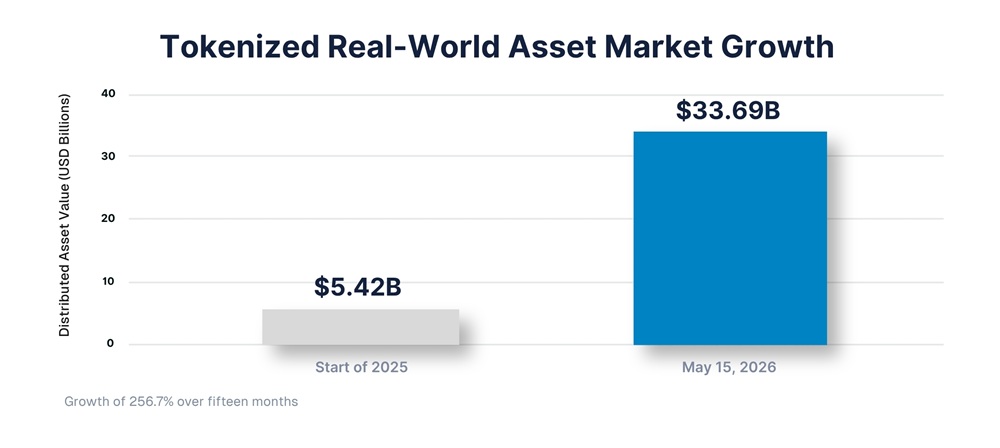
Source: RWA.xyz, cited in SQ Magazine’s Asset Tokenization Statistics 2026
This expansion carries implications beyond convenience. Fractional structures open up new liquidity possibilities for assets historically locked into multi-year hold periods, while also raising fresh questions about reporting standards and transparency across private markets. It should be noted that the tokenization of real-world assets widens who can invest and how easily they can trade their stake, but it does not change what the underlying asset itself is worth. That distinction matters, since the inflation protection still comes from the property, infrastructure, or commodity being tokenized, not from the token wrapped around it.
Risk Management and Due Diligence Considerations
Real asset investing, whether through conventional structures or tokenized vehicles, carries risks that deserve careful examination before capital commitment. Valuation methodology varies considerably across managers, and leverage sensitivity can amplify losses during periods when financing costs rise alongside inflation itself. These are not new concerns, but they take on added dimensions once digital ownership records enter the picture.
Regulatory clarity has improved meaningfully this year. The Securities and Exchange Commission’s Statement on Tokenized Securities, issued January 28, 2026, confirmed that assets represented on blockchain infrastructure remain fully subject to existing federal securities laws regardless of the technology used, as detailed in Lathrop GPM’s analysis What Tokenization Doesn’t Change. Custody arrangements deserve particular attention here, since a tokenized ownership record is only as reliable as the entity safeguarding the underlying asset. Market participants hold varying views on how quickly infrastructure will mature to support institutional-scale activity, and that spread of opinion is itself a useful signal that due diligence frameworks are still catching up to the pace of product innovation.
Positioning Private Capital for the Next Economic Cycle
Real assets, disciplined portfolio construction, and technological innovation are converging in ways that would have seemed unlikely a decade ago. Property and infrastructure still offer the structural traits that make them credible tools for preserving purchasing power. Digital access mechanisms, meanwhile, are widening the pool of investors able to participate meaningfully.
Forward-looking allocation intentions suggest this convergence has staying power. Forty-six percent of private wealth professionals surveyed plan to increase infrastructure allocations in 2026, placing it just behind venture capital and growth equity as the most favored strategy for expansion, according to Hamilton Lane’s 2026 Global Private Wealth Survey. Inflation hedging will likely remain a defining objective for private capital as economic cycles continue to shift unpredictably. Investors positioning portfolios for the years ahead can view real assets as a diversified toolkit, with property, infrastructure, natural resources, and emerging digital structures each serving a distinct role. Key principles for the period ahead include:
-
Match allocation sizing to genuine liquidity needs rather than headline return targets.
-
Diversify across real asset subcategories to capture different inflation transmission mechanisms.
-
Monitor regulatory developments around tokenized structures before committing meaningful capital.
-
Prioritize managers with demonstrated underwriting discipline over those offering the most attractive marketing narrative.
For private market allocators, the task ahead is practical rather than predictive. Allocators should seize real asset exposure to genuine liquidity needs, diversify across property, infrastructure, and natural resources, and vet managers on underwriting discipline before committing capital to conventional or tokenized structures alike.