Investors target smaller enterprises to secure reliable returns. These
specific buyouts offer attractive entry valuations and straightforward paths
for operational improvements. Recent market trends highlight a growing
interest in lower middle market private equity.
These investments offer structural downside protection alongside extremely
stable growth opportunities. By acquiring family-owned businesses, funds can
implement rigorous professional management systems. This localized approach
drives consistent value and reduces exposure to the volatility often seen in
large corporate auctions and global market fluctuations.
The Rise of Lower Middle Market Private Equity
Capital allocators are deliberately shifting their strategic focus toward
smaller transactions across the nation. This targeted segment offers unique
demographic advantages and extremely favorable pricing dynamics for early
investors.
Buyers can effectively capitalize on generational transitions and fragmented
regional supply. These combined factors create an environment fully ripe for
disciplined acquisition strategies and sustained portfolio expansion.
The current financial market benefits immensely from unprecedented ownership
transitions. According to comprehensive industry analysis, between 10,000 and
12,000 small business owners will consistently pursue exit transactions
annually through 2035.
This demographic wave creates an exceptionally dependable pipeline of prime
acquisition targets. Investment funds can secure lucrative proprietary deal
flow without ever engaging in some of the most contested bidding wars.
-
Favorable Valuation Multiples
Entry valuations remain attractive compared to larger enterprise segments.
According to
Avante Capital, early 2026 market data shows that smaller transactions averaged 8.2x
EBITDA (Earnings Before Interest, Taxes, Depreciation, and Amortization).
On the other hand, the large-cap deals consistently cleared at 12.1x EBITDA.
Acquiring fundamentally sound companies at lower multiples provides an
immediate structural financial advantage. This critical valuation gap
thoroughly protects initial capital while establishing a strong foundation
for future expansion.
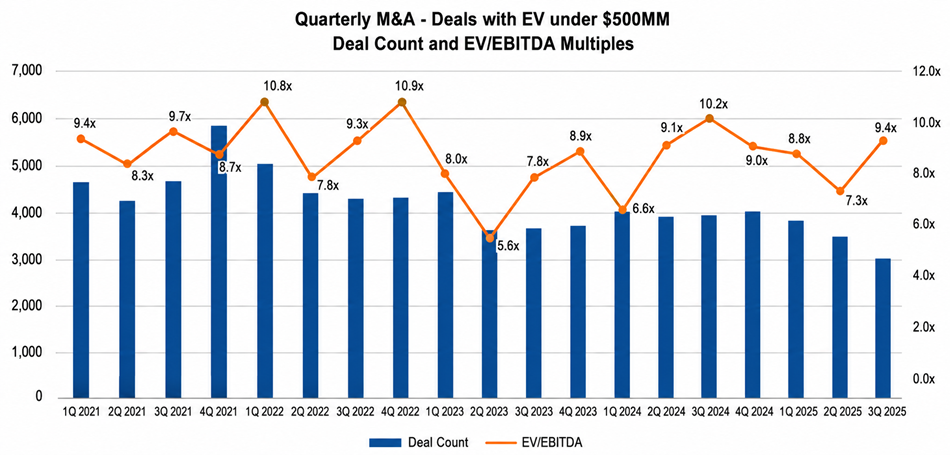
Source:
Diamond Capital Advisors. Middle Market M&A Deal Volume &
Valuation Multiples.
-
Reduced Auction Competition
Smaller regional deals naturally attract far fewer institutional bidders. A
typical local auction involves only three to five serious participants.
Buyers can thoroughly evaluate key operational areas such as:
-
Historical financial accuracy
-
Core customer retention
-
Existing supply chains
This limited competition prevents irrational pricing. The complete absence of
intense bidding wars ensures that final purchase prices remain perfectly
aligned with underlying fundamental asset value.
Core Value Creation in the Lower Middle Market
Complex financial maneuvering takes a necessary back seat to fundamental
operational improvements in this sector. Funds generate enduring value by
modernizing legacy systems and firmly institutionalizing daily processes.
This hands-on management approach effectively transforms regional businesses
into extremely scalable national platforms over time.
-
1. Professionalizing Family Businesses
Founders often reach an operational growth ceiling due to limited internal
resources. Private equity sponsors seamlessly introduce advanced financial
reporting and modern human resource management frameworks.
These strategic upgrades require minimal initial capital but consistently
yield significant long-term efficiency gains. Implementing sophisticated
business management software frequently eliminates hidden redundant costs.
Such fundamental structural changes perfectly prepare the company for
scalable future growth and broader geographic market penetration.
-
2. Margins and Operational Efficiency
Operating margins expand quite rapidly when institutional best practices are
fully applied. Investors focus primarily on several key actionable areas to
drive profitability aggressively:
-
Upgrading outdated legacy accounting software.
-
Restructuring restrictive vendor supply contracts.
-
Expanding digital marketing and sales efforts.
-
Recruiting very experienced executive leadership.
These targeted management interventions can improve internal profit margins
significantly over a standard holding period.
-
3. Examining Lower Middle Market Private Equity Returns
Historical performance data strongly validates the continued focus on smaller
regional deals. The combination of lower purchase prices and direct
operational improvements generates substantial financial yields.
Risk-adjusted investment metrics consistently favor these exceptionally
targeted and methodical investment strategies.
-
4. Superior Net Return Performance
Return profiles in this specific segment consistently outpace broader
financial market indices. Over the past decade, it has delivered a median net
Internal Rate of Return (IRR) of 15.8%, easily outperforming the 11.2%
generated by large buyout funds.
This recorded financial outperformance remains extremely consistent across
varying unpredictable economic cycles. The verifiable data confirms that
smaller targeted acquisitions yield compelling results.
-
5. Private Credit as a Growth Engine
Unrestricted access to the flexible financing plays a significant role in
advancing smaller buyouts. By late 2025, private credit became the primary
funding source for these lower middle market transactions, with related
Assets Under Management reaching USD 1.7 trillion.

Source:
U.S. Middle-Market M&A in 2026, Cascade Partner
Specialized direct lenders confidently provide extremely customized debt
solutions that traditional commercial banks cannot offer. This reliable
capital access directly allows proactive sponsors to execute complex
acquisitions with total operational confidence.
-
6. The Valuation Expansion Effect
Successful companies naturally command significantly higher enterprise
valuations as they scale. A regional firm purchased at six times earnings can
often be sold for ten times of earnings following professionalization. It
tends to lead to valuation increases always occurs through specific
measurable milestones:
-
Diversifying the core customer base.
-
Expanding into entirely new geographic territories.
-
Developing exceptionally predictable recurring revenue streams.
-
Securing profitable long-term enterprise contracts.
Sourcing Strategies for the Lower Middle Market
Identifying genuinely high-quality assets requires very specialized
origination networks. Standard investment banking channels rarely capture the
most profitable proprietary deals available. Successful funds deliberately
build deep local relationships directly with business owners and trusted
regional financial advisors.
-
Overcoming Data Limitations
Readily accessible public data is extremely scarce for privately held
regional companies. Resourceful investors consistently overcome this data
challenge by rapidly deploying immensely dedicated origination teams. These
trained professionals diligently source fresh opportunities through various
localized channels:
-
Regional wealth managers.
-
Boutique local accounting firms.
-
Niche industry trade associations.
-
Targeted direct outreach campaigns.
This sourcing approach uncovers targets before they hit the broader national
market.
-
Expanding Buyer Participation
New buyer categories are swiftly entering the space to capitalize on low
entry costs fully. According to
CapitalPad’s
Lower Middle Market Private Equity Statistics, platform buyouts ranging
strictly between USD 10 million and USD 25 million in enterprise value
averaged 5.9x EBITDA through late 2025.
This attractive pricing effectively draws numerous family offices and new
independent sponsors. Despite increased market participation, the sheer
volume of retiring founders ensures ample prime supply remains easily
available.
Risk Mitigation in Smaller Buyouts
Protecting principal capital is equally critical as generating high financial
yields. Smaller investments inherently face unique operational risks
regarding narrow customer concentration and key personnel reliance.
Thoroughly diligent underwriting directly helps cautious investors navigate
these specific vulnerabilities effectively.
-
Conservative Leverage Usage
Smaller regional companies cannot support excessive debt burdens. Careful
sponsors systematically use conservative funding structures to help ensure
long-term financial stability.
Industry market data from early 2026 clearly shows that average debt levels
for smaller targets stood safely at 2.5x EBITDA, compared to 5.2x for larger
corporate counterparts. This prudent debt utilization fully protects lower
middle market firms during severe economic downturns.
-
Structural Downside Protection
Extremely low entry multiples organically provide a heavily built-in margin
of safety. If projected growth initiatives completely fail to materialize,
funds can still confidently generate positive financial returns through
steady debt paydown and strong cash flow generation. High cash conversion
rates actively allow small companies to weather temporary revenue disruptions
effectively. This intrinsic financial resilience appeals very strongly to
risk-conscious institutional investors globally.
Conclusion
Smaller enterprise buyouts represent a highly compelling long-term investment
strategy. The combination of favorable demographics, exceptionally low entry
multiples, and vast operational upside constantly creates a resilient return
profile.
As large-cap auctions become increasingly saturated and overpriced,
intelligent funds will continue migrating downward to find true intrinsic
value. Dedicated investors who partner with deeply experienced operators in
this specific space will capture sustainable long-term gains effortlessly.