Investing in life sciences in 2026 requires understanding clinical trials, regulatory pathways and market needs. The global healthcare funding landscape has stabilized after recent financial fluctuations. Investors prioritize personalized medicine and artificial intelligence in drug discovery. A successful Biotech venture capital strategy relies on funding startups that solve specific medical problems with demonstrable scientific evidence.
This guide explains how funding works in the medical field and provides comprehensive insight into the evaluation process and common risks. Also, explore the major trends shaping healthcare investments this year. Funding medical research is crucial for human health, as it brings life-saving treatments from university laboratories to hospital pharmacies.
The Current State of Biotech Investments
Understanding the current financial climate is the first step for any healthcare investor.
This year presents a cautious environment for life science funding. According to a latest report by the National Institutes of Health, early-stage medical funding increased by 12% compared to the previous year.
A rising need for better treatments for chronic diseases, driven by an aging global population, drives this growth as biotech venture capitalists typically seek companies with a strong scientific foundation.
The focus has shifted from rapid expansion to sustainable growth. Startups must show a clear path to generating revenue. They need to demonstrate how they will get approval from regulatory bodies like the Food and Drug Administration (FDA).
This regulatory approval is a major milestone. Without it, a medical product cannot be legally sold to patients. Investors evaluate the management team to determine whether they have experience securing these approvals. Having a veteran team greatly increases the likelihood of successfully navigating complex health regulations.
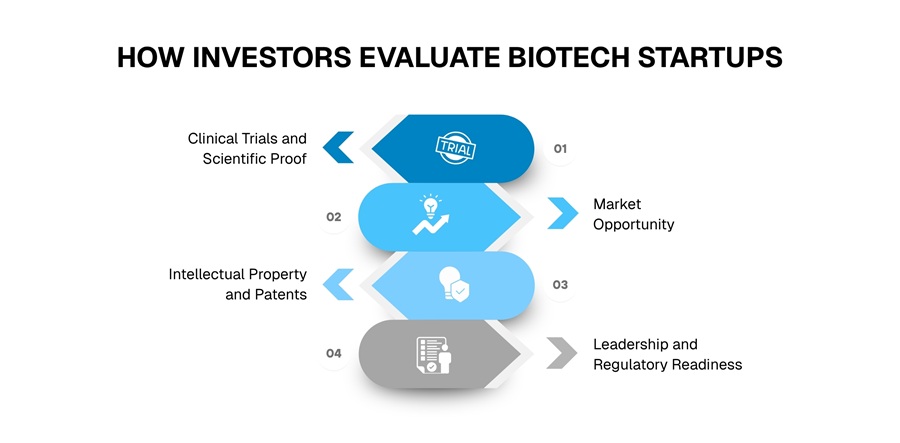
How Investors Evaluate Biotech Startups
Evaluating a biotech startup involves examining its science, leadership team, and market size.
-
1. Clinical Trials and Scientific Proof
Investors spend a lot of time reviewing data from clinical trials. Clinical trials are research studies performed on people to evaluate a medical, surgical, or behavioral intervention. For example, if a startup develops a new diabetes pill, investors want to see results from testing it in patients. They look at whether the pill lowers blood sugar safely without causing harmful side effects.
A biotech venture capitalist often works with scientists and doctors to carefully review this information. They need technical experts to confirm that science is real and effective. This process is called due diligence. It takes several months of deep investigation before any money is transferred to the startup.
Scientific innovation alone does not guarantee investment. Investors evaluate the size of the patient population, existing treatment options, reimbursement potential, and future market demand. Although rare diseases affect fewer patients, successful therapies often command premium pricing because they address conditions with limited treatment alternatives.
Understanding future healthcare demand helps investors estimate long-term commercial success.
-
3. Intellectual Property and Patents
Strong intellectual property significantly increases investment attractiveness. Patents provide exclusive rights to manufacture and commercialize new drugs, therapies, or medical technologies for a defined period. Without adequate patent protection, competing companies can replicate innovations, reducing long-term profitability.
Before investing, firms carefully review patent portfolios and public intellectual property databases to verify that a startup's technology remains adequately protected.
-
4. Leadership and Regulatory Readiness
Even exceptional science requires capable leadership. Investors assess whether founders and executives possess experience in clinical development, regulatory affairs, manufacturing, and commercialization. Teams with proven success in obtaining regulatory approvals often inspire greater confidence because they understand the complex challenges involved in bringing healthcare innovations to patients.
Risks and Rewards in Life Sciences
Funding healthcare innovation involves high financial stakes and the potential for massive scientific breakthroughs.
-
The Challenge of Clinical Failures
The medical funding field is known for high failure rates. Most new drugs fail during clinical trials because they are either unsafe or ineffective for the general population. A drug might work perfectly in laboratory mice but fail when tested in humans.
This means that a large portion of Biotech venture capital is lost on unsuccessful projects. Investors must be comfortable with losing their entire investment in a specific startup. To manage this risk, investment firms build large portfolios.
They invest in multiple healthcare companies simultaneously. If one company fails, another might succeed and cover the financial losses. This diversification is a standard practice in modern finance.
When a medical startup succeeds, the rewards are significant. A successful new treatment can improve the lives of millions of people globally. It can also generate massive financial returns for the early investors. For instance, a startup that successfully develops a new cancer treatment can be acquired by a large pharmaceutical company for billions of dollars.
This financial reward encourages investors to keep funding risky scientific research. According to a 2026 World Health Organization publication, private funding is an essential component for bringing new medicines from the laboratory directly to the hospital setting. Without private investors, many cures would never reach the public.
Key Subsectors Attracting Funding in 2026
Certain areas of medical research are currently receiving the most attention and money from investors.
Investors are focusing their money on a few specific scientific areas this year. These subsectors show the most promise for treating complex diseases effectively.
| Subsector |
Description |
Real-World Example |
| Gene Therapy |
Altering human genes to treat or stop disease. |
Funding a startup that fixes faulty DNA to cure genetic blindness. |
| AI Drug Discovery |
Using computers to find new medicines faster. |
Investing in software that predicts how a drug will react in the body. |
| Personalized Medicine |
Tailoring medical treatment to individual characteristics. |
Developing cancer treatments tailored to a patient's specific tumour profile. |
| Medical Devices |
Creating physical tools used for medical purposes. |
Developing a new, less invasive surgical robot for heart operations. |
The table above shows where the most financial activity is happening today. A smart Biotech venture capitalist stays updated on these specific trends. They need to know which technologies are gaining regulatory approval, and which ones are struggling in clinical trials.
Artificial intelligence is gaining widespread adoption in drug discovery because it can accelerate the slow process of discovering new drugs. By using computers to simulate chemical reactions, startups can save millions of dollars in laboratory costs.
Steps to Enter the Biotech Venture Capital Field as an Investor
Starting a career in healthcare investing requires a clear path of education and practical experience. Entering this specific field requires a unique blend of scientific knowledge and financial skills.
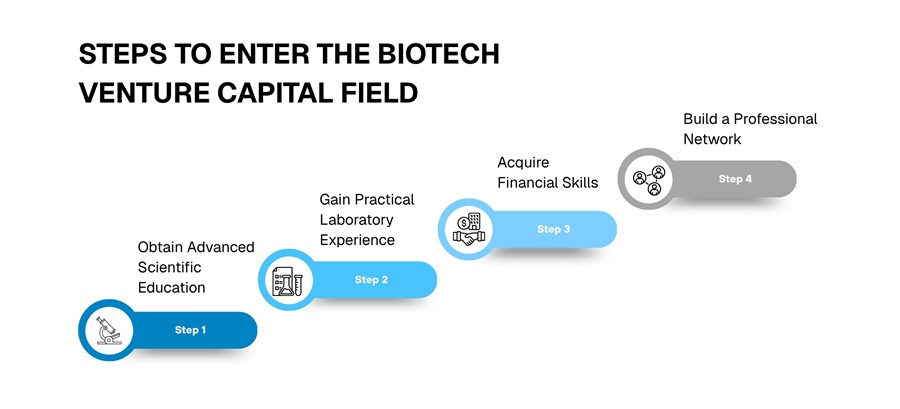
Here are the common steps professionals take to build a career in this industry:
-
1. Obtain Advanced Scientific Education: Most successful professionals start with an advanced degree in science. A doctorate in biology or chemistry provides the necessary foundation to understand complex medical technologies.
-
2. Gain Practical Laboratory Experience: Working in research laboratories or at large pharmaceutical companies is crucial. This hands-on experience gives future investors a deep understanding of the daily challenges scientists faces and the timeline for developing new medicines.
-
3. Acquire Financial Skills: Transitioning into investment banking or corporate finance is a common next step. Learning financial modeling is essential for accurately calculating potential profits and evaluating the financial health of startups.
-
4. Build a Professional Network: The final piece of Biotech venture capital is professional networking. Investors must build strong relationships with university researchers, startup founders, and other financial professionals to find new companies that need early funding.
According to the National Science Foundation in 2026, combining these cross-disciplinary skills is the single most critical requirement for modern technology and healthcare investors.
Conclusion
Investing in life sciences continues to play a pivotal role for global health improvements.
The landscape of funding medical startups in 2026 demands a careful balance of scientific understanding and financial strategy. Investors play a vital role in bringing life-saving treatments from concept to reality. They must navigate high risks, complex clinical trials, and strict regulatory pathways.
By focusing on promising subsectors like gene therapy and artificial intelligence, funding professionals can support innovations that transform patient care globally. Ultimately, providing capital to healthcare startups is an essential function that drives the entire medical industry forward. It ensures that the next generation of medical breakthroughs reaches the patients who need them most.