In simple terms, DPI in private equity tells you how much cash a fund has actually returned to investors compared with how much investors have actually paid-in. The calculation is cumulative distributions divided by paid-in (called) capital. A DPI of 0.50 means investors have received back half of what they contributed so far, while 1.00 means they have received back an amount equal to their contributions.
Because private funds are large and widely held, DPI has real-world relevance. The U.S. SEC’s Private Fund Statistics show USD 26.9 trillion in gross assets reported on Form PF in 2025 Q3, across 54,392 private funds, which is why clear performance metrics matter.
Scope and Interpretation of DPI
DPI is a cash-based metric that measures realized cash returned to LPs (Limited Partners). It looks only at distributions that have already happened, not what a fund might distribute in the future.
That makes DPI useful for one clear question: “How much money have limited partners received back, relative to what they have contributed?” For this reason, DPI in private equity is widely used to assess the extent to which invested capital has been returned to investors through realized distributions.
DPI Does Not Show the Value Still Inside the Fund
DPI can understate performance when a fund holds valuable companies that have not been sold yet. If a fund has strong unrealized holdings but has not exited them, DPI can be low even when the fund is doing well.
DPI also does not capture timing. Receiving USD 100 back over two years is not the same as receiving USD 100 back over ten years, but DPI treats them the same.
The Two Building Blocks: Distributions and Paid-In Capital
Now that you know what the ratio does and does not tell you, the next step is understanding the two numbers inside it.
-
What Counts as “Distributions”
Distributions are the amounts a fund returns to limited partners. Most commonly, this comes from selling portfolio companies or partially selling positions. Some funds also distribute dividends or interest received from portfolio companies.
Reporting details matter. For example, some fund agreements include “recallable distributions” (money that can be called again later). The Institutional Limited Partners Association (ILPA) glossary notes that recallable distributions should be included in the numerator of DPI, and reinvested capital from those recallable distributions should be included in the denominator.
-
What “Paid-in Capital” Means in Fund Reporting
Paid-in capital is the amount investors have actually contributed after receiving capital calls. It is not the same as committed capital.
The concept may be summarized as follows:
-
Committed capital is the promise.
-
Paid-in (called) capital is what has actually been transferred.
This distinction is important because DPI uses paid-in capital in the denominator. If two funds have the same committed capital, but one has called more capital early, their DPI can differ even if distributions are similar.
Steps to Calculate DPI
With the inputs clear, you can calculate DPI consistently and avoid mixing up committed and paid-in amounts.
-
The DPI formula private equity uses
The standard formula is DPI = cumulative distributions divided by paid-in capital.
The Business Development Bank of Canada (BDC) glossary describes DPI the same way and explains the basic interpretation of 1.0 and higher multiples.
-
Worked example with realistic numbers
Assume a buyout fund has a USD 200 million commitment from all limited partners.
-
By Year 4, the manager has called USD 120 million. This is the paid-in capital.
-
Over those four years, the fund sold two portfolio companies and distributed USD 60 million back to investors.
DPI = USD 60 million ÷ USD 120 million = 0.50x
This means the fund has returned 50 cents for every USD 1.00 investors have contributed so far.
Now assume that in Year 7 the fund exits a larger investment, and total cumulative distributions rise to USD 150 million, while total paid-in capital rises to USD 130 million.
DPI = USD 150 million ÷ USD 130 million = 1.15x
At 1.15x, the fund has returned the original paid-in capital and an additional 15% on top, in the form of distributed proceeds.
-
Net versus gross DPI (why fees matter)
Some materials and reports present DPI “net” to limited partners. In that case, the figures reflect the impact of management fees and carried interest before the DPI ratio is calculated.
When you compare funds, do not assume every DPI number is built in the same way. Confirm whether the report is net to LPs, how expenses were treated, and whether any recycling or recallable features affect the numerator and denominator.
How to Interpret DPI Across the Life of a Fund
The calculation is only half the work. The real value comes from reading DPI in the context of time and fund stage.
-
Early years: a low DPI can be normal
In the first few years, many funds are still buying companies and improving them. During that time, cash outflows often exceed inflows, so DPI can be near zero.
A low DPI in years 1 to 3 is not automatically a bad sign. It can simply mean the fund is still in its investment period and has not reached meaningful exits yet.
-
Mid-to-late years: DPI becomes a liquidity score
As the portfolio matures, the expectation changes. Distributions typically rise as companies are sold, making DPI more indicative of realized returns.
This is where DPI in private equity becomes most informative, because it reflects whether investors are getting cash back, rather than returns based solely on estimated valuations.
-
Do not interpret DPI alone
Two funds can show the same DPI and still be in very different positions.
Example:
-
Fund A has a DPI of 0.80 and still owns several companies with meaningful remaining value.
-
Fund B has a DPI of 0.80, but most remaining holdings are small or struggling.
Both are 0.80, but investors may view them very differently once they add residual value. This is why DPI is usually paired with other metrics, such as RVPI (residual value to paid-in) and TVPI (total value to paid-in).
Common Pitfalls That Can Make DPI Misleading
Once you start using DPI in diligence or monitoring, these are the issues that most often lead to wrong conclusions.
-
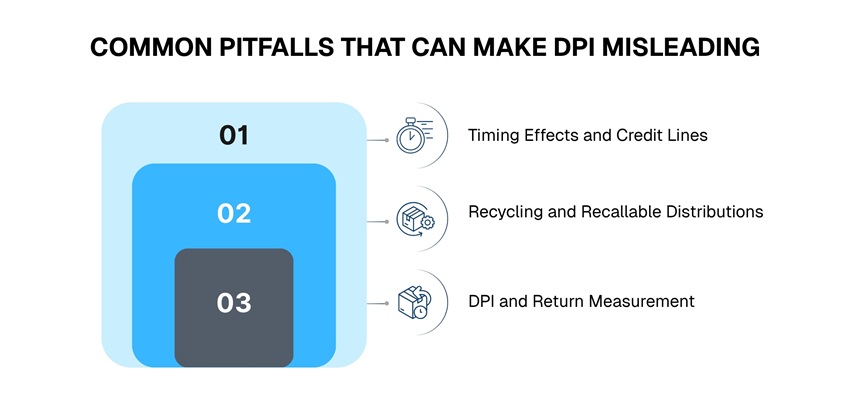
1. Timing Effects and Credit Lines
Some funds use short-term borrowing to manage capital calls and cash timing. If borrowing delays capital calls, paid-in capital may look lower at a point in time, which can lift DPI temporarily.
The right way to handle this is not to “adjust” DPI without a clear policy. Instead, read the fund’s reporting notes and compare funds on a like-for-like basis.
-
2. Recycling and Recallable Distributions
Certain funds allow the manager to reinvest proceeds from early exits back into new deals. In such cases, investors may receive a distribution, followed by a subsequent capital call to finance additional investments.
In these situations, it matters how the fund defines and reports recallable distributions. ILPA’s glossary guidance is useful here because it highlights that recallable distributions are included in the numerator, and reinvested capital from them is included in the denominator.
-
3. DPI and Return Measurement
DPI can be boosted by returning capital early, even if the overall outcome is only average.
For example, a fund could return USD 1.00 for every USD 1.00 paid-in (DPI of 1.0) after many years. That is “capital back,” but it may not be an attractive investment after accounting for time and risk.
Master the Secondary Market in Private Equity
Liquidity solutions, buyer-seller dynamics, and real-world context. All in one place.
Download Now
How DPI fits with TVPI, RVPI, and IRR
To make DPI actionable, place it next to the other metrics for most LP reports to show.
A Glance at the Common Private Equity Metrics
|
Metric
|
What it answers
|
What it can miss
|
|
Distributed to Paid-In (DPI)
|
How much cash has been returned vs. paid in
|
Remaining portfolio value and timing
|
|
Residual Value to Paid-In (RVPI)
|
How much value remains vs. paid in
|
Whether the value will be realized at exit
|
|
Total Value to Paid-In (TVPI)
|
Total value (distributed + remaining) vs. paid in
|
Timing and the uncertainty of unrealized values
|
|
Internal Rate of Return (IRR)
|
Annualized return based on timing of cash flows
|
Can be sensitive to early cash flows and assumptions
|
For a practical workflow, use DPI for liquidity, then check TVPI to understand “cash returned plus value still held,” and finally use IRR to understand timing.
This is also where the DPI formula private equity reports become a checklist item, because a clean calculation is what makes comparisons meaningful.
Conclusion
This is the simplest way to remember the metric: DPI in private equity is a score of realized cash returned versus cash contributed. Although it is straightforward to calculate and interpret, it should not be relied upon as a standalone measure of performance. For a reliable view, pair DPI with residual value (RVPI), total value (TVPI), and a timing-based metric like internal rate of return (IRR).