Introduction
In private equity, expansion is seldom achieved in a single big step. Instead business expands over series of smaller,
well-selected steps, and this is where the bolt-on acquisition strategy comes in. Rather than making massive takeovers, companies are also acquiring complementary companies for their already existing portfolios. This approach accelerates growth, enhances capabilities, and sharpens competitive advantage. Bolt-on acquisition have become critical in the contemporary deal landscape for anyone who tracks current ongoing trends of acquisitions in private equity.
What is a Bolt-on Acquisition?
Bolt-on acquisition is a directed strategic action in which a company, usually partially supported by private equity, equips itself with a smaller company to become an accomplished platform business instead of acquiring a new independent enterprise. It is quite unlike the establishment of a new platform or a merger of two giant peers.
Key characteristics of a bolt-on acquisition:
-
It focuses on businesses that are similar in terms of product, geography, or customer base to an already existing portfolio company so that it can easily integrate with it and grow faster.
-
The deal size and risk profile are less than usual acquisitions since the target is relatively smaller and already incorporated within the management structure of the buyer.
-
Value-creation-wise, the strategy allows the operations to run at synergies (shared platforms, cost efficiency) and in the market (cross-selling, faster world cover), which may be more difficult to realize through organic expansion.
Strategic Logic: Why Private Equity Favors Bolt-on Deals
The aggressive approach of a bolt-on acquisition in the world of private equity is a strategy, as opposed to a revolution. It is in conformity with purposeful capital mobilization, operational accuracy, and fast-scaled operations in a disciplined manner.
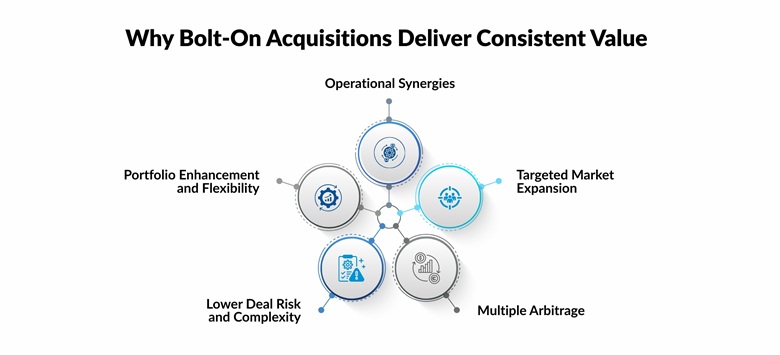
Why this strategy appeals:
-
Operational Synergies: A portfolio company can consolidate the back-office operations, increase its procurement leverage, and consolidate platforms more effectively by acquiring smaller, complementary companies. This allows saving costs and acceleration of the margin.
-
Targeted Market Expansion: A bolt-on enables market expansion into a new geography or product vertical with the footprint and resources of an existing platform. It's fast; the lower speculative growth speed is the result of its plug-in nature.
-
Multiple Arbitrage: Companies are able to buy out smaller companies at lower valuation multiples and put them into the already-established portfolio company, which usually has higher multiples. This produces an instant value addition without necessarily using organic growth.
-
Lower Deal Risk and Complexity: Due to smaller and focused targets, integration is simpler: financing is usually less leveraged, and regulatory obstacles are usually lighter. A 2025 study conducted by KPMG International reported a narrower value creation evident in bolt-on acquisitions and a reduced number of extreme failures in contrast to large mergers.
-
Portfolio Enhancement and Flexibility: Bolt-ons add to existing holdings instead of replacing the major platforms, which enables the private equity firms to expand the business they have acquired or upgrade a malfunctioning area, or create a new one. This helps in preparing exits because of better performance figures and structural appeal to the later purchasers.
The Anatomy of a Successful Bolt-on Acquisition
A bolt-on acquisition succeeds only when strategy and execution move in sync. It’s not just about buying a company; it’s about seamlessly attaching a complementary business that enhances the parent company’s capabilities, reach, or market strength. Each stage, from target selection to post-deal integration, demands precision, discipline, and alignment.
-
Selecting the right target
An effective bolt-on acquisition begins with the identification of a firm whose people, culture, and strategy can fit on the existing platform. Perfect targets occupy a void in the ability or market as opposed to replicating an existing one. A careful due diligence of the leadership chemistry, technology, finance, and the like would provide a smooth integration and value preservation.
-
Integration planning and execution
Once the target has been selected, it is necessary to have a properly designed integration plan. Key elements include:
-
Coachability of objectives between the platform and the bolt-on entity.
-
Stated operation milestones and allocated resources to achieve them.
-
Preliminary consensus on culture, incentives, and governance to reduce disturbance.
According to a 2025 Gain.pro study, firms using structured buy-and-build strategies report up to 14% higher portfolio returns than those relying solely on organic growth.
-
Post-deal value levers: data, analytics, and speed to value
The leverage should be apparent and fast to provide value. They typically include:
-
Scalability of the infrastructure of the target on the platform.
-
Expansion or cross-selling opportunities or new markets, or adjacent ones.
-
Utilization of data and analytics can discover immediate growth or savings.
The more quickly the integration team works, the more quickly that acquisition can shift out of a cost center and into a value creator. An effective bolt-on is developed into an energetic generator of value at the initial stage of
post-acquisition.
Measurable Benefits for Private Equity Firms and Portfolio Companies
An acquisition that is well-implemented can change both the portfolio firm and the supporting one, the private equity firm. The main advantage is that it will create scale and operational efficiency at a faster pace without the complexities of a full merger. The companies enhance their core competency, diversify the product range, and enter new geographical markets without causing significant disturbance.
In the case of private-equity acquisition strategies, bolt-ons are value multipliers. Through acquiring smaller, complementary businesses, companies are able to increase portfolio company valuations and generate multiple growth opportunities during exit. According to a report by SI‑Global, 478 bolt-on acquisitions were analyzed among private equity portfolio companies in 2025, reflecting a strong uptick in add-on deal activity.
Key benefits include:
-
Accelerated growth and quicker penetration of high-potential markets by making selective acquisitions.
-
Enhanced valuation increased EBITDA margins realized as a result of synergy.
-
Operational leverage, lean operations, and increased bargaining power amongst suppliers and distributors.
-
Capital is more of an investment risk than platform acquisitions with superior returns to incremental capital.
Critical Factors and Risks to Evaluate Before a Bolt-on Acquisition
A bolt-on acquisition can appear simple, but several pre-deal issues are critical to its success. Prior to settling a deal, companies need to consider strategic fit, cultural fit, and the complexity of integration to make sure that the acquisition enhances the platform and does not put a strain on it.
The initial task is the right target. Not all business opportunities presented on paper match the framework of operation or long-term prospects of the platform. It takes a keen insight into strategic value and financial sustainability to ensure that the acquisition venture by the private equity firm is strategic and not merely an increase in the number of people in the organization.
The integration plan is also vital. An effective target can easily fail when it is not well integrated. Companies must map out well-defined road maps that include harmonization of technology, retention of talents, and organizational communication systems to prevent post-merger upheavals.
Investors should also consider governance and regulatory factors before investing their capital to avoid compliance challenges that are likely to halt or kill the deal.
The most important aspects to consider encompass:
-
Overlapping operations and possible cost synergies.
-
Scalability of the merged organization.
-
Compatibility between cultures in management teams.
-
Viable schedules of assimilation and value generation.
Conclusion
Supplier bolt-on acquisition strategies are no longer a tactic to grow; they are becoming a smarter, more targeted value creation tool. Complementary business targeting allows companies to consolidate their presence in the market without complications involved with full-scale mergers. It is a model that encourages effective capital utilization, agile operations, and scalable impact. The next generation of industry leaders will still be made by private-equity firms specializing in
bolt-on acquisitions as the market dynamics change.