Introduction
The private equity firms are resorting to advisors who can sort through the noise and explain where actual value lies. This turn is indicative of a market in which sharper assessments, faster diligence, and stronger operating insight are much more important than deal flow based on volume. The consultants operating in this space assist investors to test assumptions, refine strategies, and make decisions on a tighter timeline. Their contribution serves capital in search of smarter methods of evaluating risk and enhancing performance at every phase of the investment cycle.
What Modern Consulting to Private Equity Looks Like Across the Deal Cycle
Contemporary advisory in the private equity market is provided throughout all deal phases, and the market intelligence and value creation planning are made to flow in a single disciplined work stream. The deal teams use consultants to help in interpreting noisy data, criticizing management projections, and converting macro shifts into practical implications for targets. The 2025 study by the Boston Consulting Group, The Brave New World of Dealmaking in the Global Market, reports that the global value of deal transactions in the private equity market has increased 38 percent to date through the first three quarters of 2025, which increases the pressure on quick, quality analytics of live transactions.
-
At the beginning of the cycle, market scans and initial commercial diligence are conducted by the consulting professionals in the private equity department, to enable sponsors to prioritize targets, refine investment theses, and determine whether further efforts are worthwhile.
-
During confirmatory diligence, consultants put revenue drivers, cost structures, churn dynamics, and technology resilience to the test and develop models that reveal upside levers and latent fragilities.
-
After closing, advisors become value creators, where the management and the investors are aligned on a sequenced plan that monitors performance and recalibrates the initiatives as the market conditions or operational realities vary.
Strategy Consulting Inputs That Elevate Private Equity Performance
The financial advisors who sit next to investors create an impact on the themes that are capitalized and the conviction that is made towards deals.
In strategy consulting for private equity, teams integrate the sector research, competitor analysis, and macro trends into the theses that can survive the scrutiny of the committee.
Project work connects business upside and business viability in such a way that pricing, cost profile, and digital preparedness are considered as one narrative. The growing pressure of returns has led to a greater dependence on formalized value creation strategies, in which the input of advisory services tends to decide which opportunities pass through the initial phase of interest to the signature of term sheets.
The study conducted by Alvarez and Marsal titled From Promise to Returns: Value Creation and Exits in ASEAN Private Equity 2025 indicated that over 60 percent of funds hire external consultants to develop value creation plans before and subsequent to closing; however, only 21 percent of funds hire external consultants to implement them.
-
Refines the theses of sectors with a scenario design that balances alternative courses of revenue and margin development as well as capital intensity.
-
Creates value in deal teams, operating partners, and management based on a measured value creation narrative rather than a gut feeling.
-
Enhances competitive auctions that require buyers to make a decision within a short time and show a unique and defensible opinion on the asset.
-
Transfers findings from portfolio reviews into the screening stage, giving deal teams a clearer foundation for future strategic direction.
Technical Rigor and Analytical Tools That Define High-Impact Engagements
Technical rigor in the assignments of private equity consulting is based on disciplined analytics, which can survive scrutiny of the investment committee. The engagement teams incorporate definite hypotheses and financial modeling information, market research, and operational diagnostics to establish a grounded perception of value at risk and upside potential. The professionals who consider being in private equity or positions in strategy consulting to private equity are more willing to show it by learning these key skills at the beginning of their careers.
-
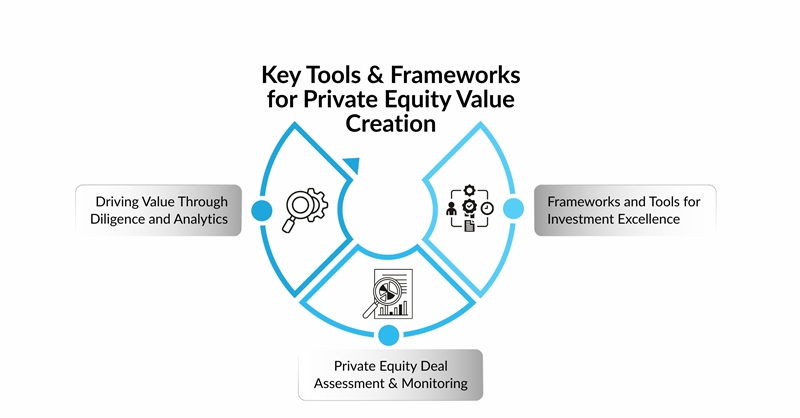
Deal screening and diligence frameworks standardize the opportunity comparison process, based on commercial, financial, and operational scorecards, which explain the level of conviction and reveal blind spots before investment of capital.
-
Sophisticated modeling, such as scenario analysis, unit economics, sensitivity testing, and cohort views, assists consulting for the clients of the private equity to understand the ability to withstand downturns, potential of upside, and when to expect significant value inflection points.
-
Digital toolkits, including automated data pipes and interactive portfolio dashboards, facilitate ongoing tracking of value creation levers; a 2025 survey by Alvarez and Marsal found that 46 percent of leaders in private equity now consider value creation planning part of the diligence process.
Talent Pathways and How to Get into Private Equity Through Consulting Roles
Consulting is a strong starting point to a career in private equity, and this is important since the talent that comes into these positions will directly determine the amount of value that PE firms can derive from every investment. Many consultants gain early exposure to commercial assessments, operational reviews, and strategic modeling, which helps them understand how investors evaluate businesses. This combination of analytical depth and project diversification prepares candidates to make a meaningful contribution in the course of due diligence and value creation. Companies are usually seeking individuals who are capable of making swift transitions from insight to action, particularly when time is of the essence and decisions carry significant weight.
Consultants with an interest in the private equity sector are likely to focus on two common avenues:
-
Consultants move into investment roles, when they have accumulated experience in multiple deal cycles, gained familiarity with the sector, and proven capable of analyzing the strengths of the business without the use of large financial templates. The route is appropriate for people who like to work directly with investment teams and define the direction of possible acquisitions.
-
Others become advisors or value-creation experts on a contractual basis, establish a record of success in deal support or post-close transformation, and subsequently become full-time PE.
The Evolving Collaboration Between Consultants and PE Operating Teams
Consultants and operating teams are now integrated much more closely, developing a partnership model that makes decision-making processes stronger along the ownership cycle. Companies seek advisors who can be next to the operators, translate complicated conclusions into actions, and assist management groups in accelerating strategic and business efforts. This change is indicative of a more general trend towards collaborative implementation over individual advisory practice, and it has restructured the ways in which value creation programs are developed and executed.
-
The use of consultants offers expert sector understanding and an analytical framework, which offers operating teams a more precise perspective of competitive forces and the measures that need to be undertaken to redefine a business when the market environment changes.
-
Operating teams use consultants to expose operational bottlenecks and create diagnostic tools used in planning, resource deployment, and timing anticipations of improvement programs.
-
Assumptions tested collectively by combined teams can enhance confidence in commercial strategies, and leadership can know what levers can produce meaningful lift within achievable timeframes.
-
PE firms also have the advantage of this combined strategy since it will create congruence among all the contributors, ease of communication with portfolio heads, and a more focused way of capturing value in the long term.
Conclusion
The consulting of private equity strengthens decision-making from the earliest look at a potential target through long-term portfolio work. Companies gain sharper strategic focus, clearer value priorities, and steadier performance as advisors help refine direction and clarify what truly drives returns.
Growing competition across deals is pushing investors to look for smarter ways to protect opportunities and strengthen outcomes. In this environment, private equity consulting becomes a practical lever for sharper execution. These advisory relationships now sit at the center of modern dealmaking, serving as a direct link between strategic intent and measurable progress.