Introduction
Private equity mobilizes targeted capital investments that directly influence employment trends, promote groundbreaking innovation, and fortify the competitiveness of key industries over decades. However, the tendency for decision-making power to concentrate among a small group of individuals remains characteristic of most industry leadership. The low representation of women in the senior ranks of private equity has substantive implications for governance, risk underwriting, and discipline in capital deployment. The expansion of women in leadership roles in private equity implies performance sustainability, institutional responsibility, and the overall stewardship that come with managing long-term investor capital.
The Current State of Private Equity Women in Leadership
Women in private equity are a minority group, especially at senior levels in the U.S. private equity industry. According to a 2025 report led by Professor Michael Ewens at Columbia Business School, women accounted for approximately 22 percent of all investment professionals, but only roughly 6 percent of senior investment roles in the 661 U.S. private equity firms. This disparity highlights a sharp decline in representation from junior and mid-level roles to senior leadership positions, indicating structural retention and promotional challenges.
❝
❝
The representation of women drops sharply at the senior investment level, revealing persistent structural barriers within firm leadership pipelines.
— Professor Ewens
The disparity does not merely concern entry-level employment. The same study found that more than 50 percent of companies had no women in senior roles at all, and the percentage of women occupying high positions in the companies had virtually no increase over the past years. In most companies, the talent pipeline usually becomes very thin as promotions go up to partner or decision-maker levels. This puts women in private equity in a disadvantageous position to influence investment strategy, governance, and portfolio management.
Several factors contribute to this imbalance. Informal networks and mentorship are often involved in career progression within the field of private equity and that are currently male-biased. Systemic biases are exacerbated by long working hours and strict timetables, increasing the attrition rates of women who could otherwise rise. These tendencies exist despite the almost equal graduation rates of women and men from business schools.
Understanding these gaps, industry organizations and companies are starting to quantify representation more stringently and pilot initiatives to support women in private equity through mentorship, explicit promotion policies, and visibility programs. Nonetheless, there is still a long way to go before number meaningful representation of top-level women leaders is achieved, and both the firm and investors will have to make long-term investments.
Investment Discipline and Governance Standards
Investment committees are built to challenge assumptions, yet homogeneity can narrow the range of questions asked. Expanding senior representation of private equity women strengthens deliberation quality and moderates concentration risk within portfolios. According to the Diversity in UK Private Equity and Venture Capital 2025 report published by the British Private Equity and Venture Capital Association, 27 percent of investment professionals are women, while only 15 percent hold senior investment roles, underscoring the limited presence of women at critical decision points. Diverse leadership perspectives introduce alternative scenario testing, refined downside analysis, and closer scrutiny of management forecasts. Decision processes become less prone to overconfidence when analytical debate reflects varied professional experiences. Drawing on a wider set of analytical frames helps uncover blind spots in valuation of assumptions and capital structuring logic.
Structural depth is also achieved in risk governance. Firms with more women in senior roles in private equity tend to implement stricter governance over leverage limits, flexibility of covenants, and operational assumptions in the turnaround. The process of monitoring does not cease at the point of the deal. Board involvement, alignment of executive compensation, and timing of exit are evaluated in a more disciplined manner.
Institutional mechanisms that give rise to stronger investment judgment include:
-
An extensive underwriting analysis that necessitates a multi-faceted review of the longevity of cash flows, industry cyclicality, regulatory risk, and positioning for a competitive advantage before capital is committed.
-
Dissent procedures at investment committees, which formalize counterarguments that require sponsors to justify assumptions regarding valuation multiples, debt structuring, and schedules of value-creating operations.
-
Portfolio governance systems where performance diagnostics are required to be repeated, an independent risk audit is required, and when the financial metrics are not met as expected by models, they should be escalated.
The high results are a result of the process of integrity rather than the comfort of the consensus. Institutional rigor minimizes the likelihood of mispriced risk and capital misallocation throughout market cycles. Long-term value creation is achieved in a more sustainable and less time-sensitive fashion when governance structures reward disciplined dissent and evidence-based judgment.
Stay Updated on Private Equity Trends With our Newsletter.
Subscribe Now
Capital Raising, Limited Partners, and Market Expectations
The capital commitments in private equity are hardly secured based on performance. Investors are becoming more critical of the depth, stability, and composition of the leadership of a firm before they invest. Diversity in investment committees has entered that assessment framework, especially when limited partners scrutinize governance standards, succession planning, and decision oversight. The publicity of women in the private equity fundraising meetings, investment committees, and portfolio management discussions often creates an investor impression of institutional maturity and long-term viability. During fundraising cycles of competition, leadership structure affects credibility, which indicates the development of long-term investment franchises as opposed to personality-based platforms.
Investor sentiment this year reflects broader industry pressures. Many limited partners are maintaining or increasing their private equity allocations in 2026, with about 70 percent planning to hold or expand exposure, according to the Global Private Markets Report 2026. Given the current competitive market for capital, companies that have proven their investments in diversity and wider leadership bases will be in a better place to draw bigger and long-term commitments.
In the institutional environment, the demands of private equity managers are moving beyond the raw returns. Limited partners are putting more stress on due diligence transparency, strict allocation policy, and depth of leadership. Companies that put women in visible leadership positions in private equity can indicate strategic benefits to investors who are interested in resilience and governance results.
Structural Barriers and Practical Reform Mechanisms
Disparities in promotion exist because the progression routes in most organizations remain based on internal patronage and not on professional criteria. The exposure of high-value deals, access to investors, and succession planning conversations are more likely to revolve around tightly connected networks limiting the visibility of women in private equity.
Revenue attribution is often the major reward of performance reviews instead of team building or governance responsiveness, and limits the basis of leadership recognition. These structural constraints can only be solved by redesigning institutions rather than symbolic commitments to diversity.
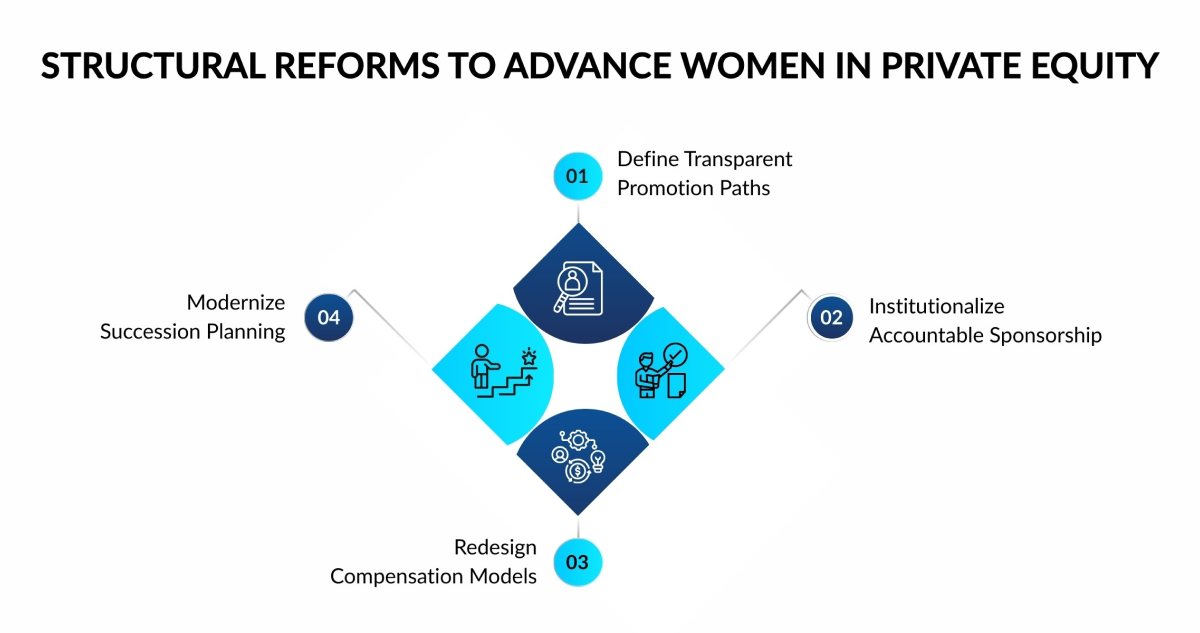
Practical reform priorities
-
Implement clear promotion structures, which explicitly set investment leadership standards, carried-interest eligibility, and partner-track schedules, to enable promotion decisions to be proven and defensible.
-
Formalize sponsorship initiatives where senior partners are rated based on talent-development results, such that women in private equity are made available high-impact transactions and investor relationships.
-
Restructure compensation frameworks to reward risk oversight, portfolio management, and long-term value generation, but not only deal-origination credits.
-
Indicators to introduce organized reviews in succession planning to include quantifiable representation targets at the level of the investment committee and managing-partner.
Long-term reform enhances institutional credibility. Companies that incorporate accountability in their governance systems are better placed to draw in high-tech capital and keep senior investment talent in the long term.
Conclusion
The future of capital formation in the modern world will be shaped by those who control investment decisions. Expanding leadership opportunities among women in private equity firms improves governance and risk analysis and contributes to disciplined succession planning in firms that are competing for top talent. Increasing the presence of women in private equity is a strategic move in a market that is becoming more complex and requires shifts in investor expectations. Sustainable performance requires the inclusion of leadership that is instilled in the top levels of capital stewardship.