Introduction
Public markets are exhibiting visible strain as liquidity tightens, pricing confidence erodes, and volatility resurfaces across asset classes. These conditions are prompting a reassessment of risk models that were shaped by years of stable financing and predictable exit paths. Capital has increasingly moved toward the private equity market, where longer holding periods and constrained exit timing alter how risk is absorbed. At the same time, debate over a potential private equity bubble reflects concern about valuation of resilience, refinancing exposure, and how delayed price discovery may affect broader market stability.
Public Market Fragility and the Search for Stability
The early 2026 market prices in the key public equity and debt markets have exhibited abnormal trends, highlighting weak balance. According to BlackRock's 2026 Global Macro Outlook report, following a long-term rally in most of 2025, the equities had low volatility, though there were underlying divergences in both corporate earnings and monetary policy signals, which indicated complacency, rather than underlying strength. The report indicated that the broad risk assets were being priced as though the uncertainty had decreased, even when there was an increasing gap in cross-country and sector performance. Such an imbalance may result in sudden re-pricing in case new data comes.
The pricing pressure is aggravated by the lack of liquidity to absorb any change in market positioning. Liquidity indicators in some of the fixed-income markets show buffers that are less than what was previously experienced. With a shrinking market depth, even small flows of orders may trigger disproportionately large price changes, forcing portfolio managers and trading desks to unwind positions faster than had been planned, resulting them to sell or buy at a loss. The dynamics have been linked to the expansion of bid-ask spreads and the reduction of dealer inventories in specific corporate and government bond markets
Once liquidity constraints arise, investors are increasingly switching their focus to the optimization of the use of protective measures. These circumstances have made institutional investors redefine their risk models. Instead of assuming the existence of smooth price discovery, a large number of analysts have added the possibility of a sudden liquidity shortage to stress tests. These amendments recognize that market stability in the public market can be more of a matter of sentiment than sound fundamentals.
A Professional's Guide to Private Equity Secondaries
Get a grounded perspective on one of private equity's fastest-growing markets.
Download the Guide →
Capital Rotation and the Expanding Role of the Private Equity Market
The capital that was previously attracted solely to public equities is taking a new turn as institutional investors adjust to a more restrictive environment. The increased volatility of large stock markets and the squeeze of bond yields have prompted certain allocators to shift money to private markets, where strategic control and value creation that is tailored to their needs is believed to be more robust. According to the 2026 Private Equity Statistics report, the global deal volume has demonstrated a recovery this year, as investors have renewed interest in private transactions.
A relative illiquidity premium that can be provided by the private structures is one factor that drives this rotation. The rate of capital investment in buyouts, growth equity, and secondary deals has increased when the level of liquidity in the public market declines. Middle-market areas previously struggling to gather bids are picking up, as an illustration, as companies become more committed to less liquid approaches, with a wider shift in the way risk and reward are evaluated.
The investors are also demanding new structures that will close the conventional liquidity gaps. The secondary markets and continuation vehicles are gaining prominence, and this enables the limited partners to have partial liquidity without complete exits.
-
Long-duration capital commitment may be used to alleviate vulnerability to the short-term pricing pressures, to allow private equity funds to nurture operational gains without the forced selling that is common in the public markets. This further enhances the attraction of the private equity market to the institutions seeking diversification.
-
Non-traditional asset accessibility in private markets, such as infrastructure or niche technology platforms, can increase the potential of returns compared to the public peers and reduce the exposure to index concentration risk.
Capital concentration within a limited pool of private deals is intensifying competition and pricing sensitivity, laying the groundwork for closer examination of valuation discipline and emerging concerns around a private equity bubble.
Valuation Pressures and the Debate Around the Private Equity Bubble
The issue of pricing tension in the private equity market is difficult to overlook, as the valuation multiples remain high despite the disproportionate operating performance in various sectors. Deal teams are compelled to explain valuations based on long-term growth assumptions, not near-term cash generation. This increased the disconnect between entry prices and part of the time prices and conservative exit expectations, as to whether current pricing is of durable fundamentals or of optimistic underwriting influenced by the bountiful capital and the resulting competitive deal processes. The debate is not about the short-term instability, but the extent to which it can withstand a tightening in economic conditions or a slowdown in growth in revenue.
A parallel concern centers on exit alignment. Long holding periods imply that sponsors are hesitant to achieve value at current market prices. In several situations, assets are being refinanced and not sold, and paper valuations are maintained, and price discovery is delayed. This dynamic dosen’t validates a bubble, but it does increase responsiveness to future changes in credit supply, consumer demand, and market standards established by the public that are used to guide private pricing models.
Taken together, the bubble debate reflects structural tension rather than consensus risk. High valuation, laggard exits, and capital concentration are coupled with active governance and operational control. The result will probably depend on how well the valuations will correct themselves in the long run, and not whether a sudden correction will come into being.
Regulatory Attention and Institutional Risk Assessment Shifts
Regulators are responding to increasing pressure in the public markets by increasing their attention to the processes by which risk accumulates and spreads across listed equities, fixed-income securities, and interconnected funding sources. The increase in volatility, faster repricing, and periods of liquidity unavailability have shifted supervisory focus toward the structure of the market as opposed to focusing on compliance at the firm level. Supervision has turned to focus on the credibility of price discovery, the willingness to redeem, and the ability of market participants to absorb sudden dislocations without contributing to the instability. This focus is informed by the fear that the pressure in the public markets may easily spread to other interconnected investment vehicles and balance sheets.
Institutional risk groups are enhancing their structures to reflect these external market forces. Portfolio reviews are increasingly putting more weight on sensitivity to interest-rate changes, funding costs, and crowding in popular publicly traded securities. Risk assessment is becoming more prospective, using scenario-based assessments that are associated with macroeconomic and policy indicators, as opposed to using past correlations solely. This shift brings risk governance into closer correspondence with the conduct of the public markets, as opposed to portfolio structure.
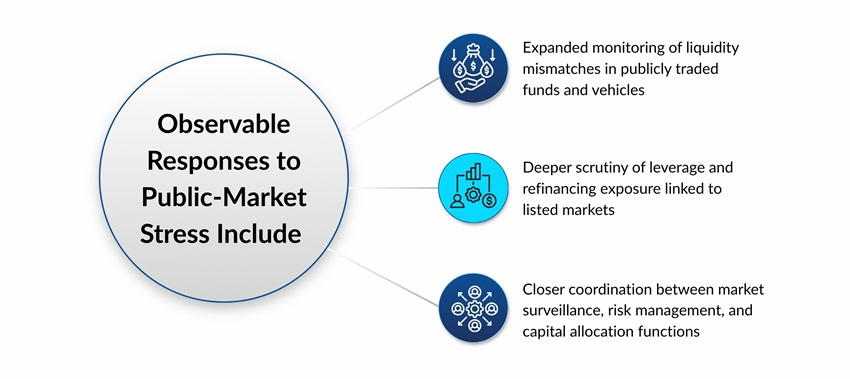
Observable responses to public-market stress includes:
-
Expanded monitoring of liquidity mismatches in publicly traded funds and vehicles
-
Deeper scrutiny of leverage and refinancing exposure linked to listed markets
-
Closer coordination between market surveillance, risk management, and capital allocation functions
Combined, these changes show that regulators and institutions are rebalancing risk management in direct proportion to the moves of public markets, instead of just focusing on internally established risk metrics.
Conclusion
Public market accumulation of stress is transforming the process of risk assessment in asset classes. With a capital flight to durability, the private equity market is under greater examination in the areas of liquidity, leverage, and valuation discipline. The discussion on a possible bubble in the private equity market represents a lack of consensus rather than agreement. Together, these forces represent the movement towards stricter evaluation of the actual location of resilience within a more constricted capital space.