If you have ever looked at a private equity deal or hedge fund pitch, you have seen labels like "for accredited investors only" or "for qualified investors only." The two words are similar to each other, although they are applied by the Securities and Exchange Commission (SEC) for very different reasons. Conflicting them may result in an issuer losing its Regulation D exemption
or putting an investor in a position of pursuing deals they are not legally eligible for.
(Regulation D is a collection of SEC rules that allows companies to raise capital by making private offerings not required to undertake the entire process of public registration, provided that they are selling largely to accredited investors and meet certain disclosure and verification standards.)
Both groups include investors considered financially sophisticated enough to handle private market risks, but each threshold falls under a different federal statute. This blog clarifies the distinction with thresholds, a real example, current SEC information, and frequently asked questions.
What is an Accredited Investor?
An accredited investor is defined under Rule 501 of the Regulation D of the Securities Act of 1933. This status decides who can invest in most private, SEC-unregistered offerings, such as private placements, venture funds, and real estate syndications.
By 2026, a person qualifies as an accredited investor by meeting any of these criteria:
-
Income test: USD 200,000 in both of the previous two years (jointly, USD 300,000) and the same is projected to be earned this year.
-
Net worth test: More than USD 1 million, less the primary home, by itself or with a spouse.
-
Credential test: Individuals holding certain professional credentials, such as a Series 7, 65, or 82 license in good standing.
The entities qualify based on having assets exceeding USD 5 million or all the owners of the equity being accredited.
How to Become an Accredited Investor?
There isn’t any formal application to help an individual become an accredited investor. Individuals also won’t find any government certification to that effect. However, the law mandatorily makes it the investment issuer’s responsibility to make sure that its investors are able to meet such criteria before enabling them to participate in one of their offerings.
As a result, issuers will require investors to validate their accreditation prior to investing, and in most circumstances, before receiving the investment offering paperwork. An issuer may ask the investor to provide supporting evidence such as tax returns, bank statements, brokerage statements, or verification of a securities license.
What is a Qualified Purchaser?
A Qualified Purchaser (QP) is an individual or entity defined under the Investment Company Act of 1940, considered sophisticated enough to evaluate complex and higher-risk private investments such as 3(c)(7) hedge funds, which are exempt from SEC registration.
By measuring investments owned rather than income or wealth, it offers a more accurate gauge of a person’s financial sophistication.
To meet the qualified investor threshold for qualified purchaser status:
-
Individuals or married couples: Are required to have at least USD 5 million of investment, without considering the primary home and business property.
-
Family companies: Investments of at least USD 5 million, and owned by two or more related persons in the family.
-
Money management entities: Have at least USD 25 million to manage on a discretionary basis.
Since it measures actual invested assets rather than income or net worth, it sets a significantly higher standard than accredited investor status.
How to Become a Qualified Purchaser?
As with accredited investor status, there is no official application and no government certification. It is the investment issuer’s responsibility to comply with the law by having investors certify that they are qualified buyers.
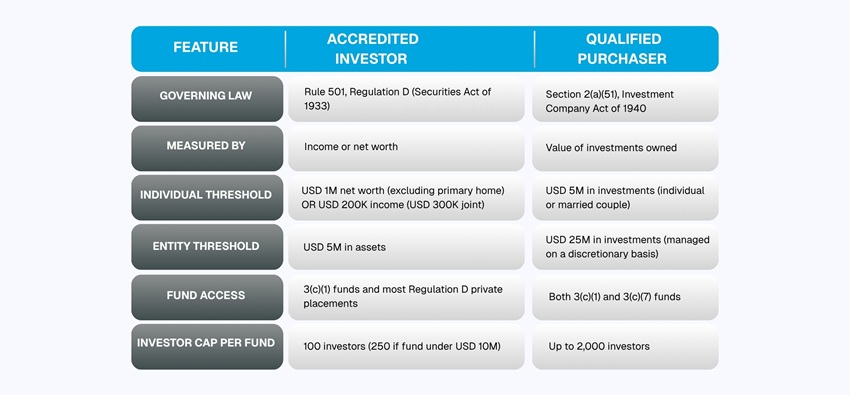
Accredited vs Qualified Investor | Side by Side
The difference between qualified and accredited investors comes down to two aspects: threshold size and fund access.
Why Does it Matter for Fund Access?
Private funds typically rely on one of two SEC exemptions that allow them not to be registered as investment companies.
The Investment Company Act of 1940 defines a 3(c)(1) fund (a private fund that is not subject to regulation under Section 3(c)(1)) as an open fund, limited to 100 beneficial owners (or 250 when the fund has less than USD 10 million assets) of accredited investors.
A 3(c)(7) fund (excused by Section 3(c)(7) of the same Act) may take qualified purchasers and admit up to 2,000 investors, which is why most large hedge funds and private equity funds adopt this structure.
The ultimate owner of an interest in the fund is a beneficial owner, who holds the ultimate economic interest in the fund, even if the investment is held through a trust, LLC, or other vehicle.
A Practical Example of Fund Access Difference
Example 1:
Focused on Accredited Investors: Private equity / venture fund
Consider a USD 100 million private equity fund, which is structured as a 3(c)(1). It can only accept accredited investors, capped at 100–250 LPs.
Result: You only get in if you are an accredited investor, but not every investor who meets the accredited threshold qualifies as a qualified purchaser.
Example 2:
Focused on Qualified Purchasers: Hedge fund or credit strategy
A more complex, liquidity-sensitive hedge fund (e.g., concentrated credit, derivatives-heavy) may
use a 3(c)(7) structure so it can employ leverage, less-liquid assets, and more opaque positions.
Outcome: Only qualified purchasers (= USD 5M in investable assets) are allowed, even if they are already accredited.
Here, the same firm can have “retail-style” access for accredited investors and “institutional-style” access for qualified purchasers.
A Real-World Example | Why Citadel Is Out of Reach for Most Accredited Investors?
The accredited vs. qualified investor distinction is well illustrated by the case of Citadel. Ken Griffin is the founder of Citadel, one of the world’s largest hedge funds. As of early 2026, he manages approximately USD 68 billion in assets and owns approximately 85% of the hedge fund firm.
Two professionals, very different access:
-
Accredited only: A physician who has a net worth of USD 1.6 million out of her residence, earning USD 350,000. She satisfies Regulation D and is able to invest in 3(c)(1) type venture funds, real estate syndications, and private placements, but her portfolio is less than USD 5 million, placing Citadel’s 3(c)(7) fund outside her eligibility.
-
Qualified purchaser: A retired technology executive with a USD 8 million brokerage account, built through a prior IPO exit. He passes both thresholds and gains access to 3(c)(7) funds such as Citadel, in addition to everything available to the physician.
Both investors appear equally wealthy to outside observers, yet the private market opportunities available to each are markedly different.
Final Takeaway
The distinction between accredited and qualified investor status carries practical consequences. It determines which private market opportunities an individual can access, and each classification presents different possibilities.
Accredited investor status establishes the minimum eligibility threshold for most private market opportunities. It covers the majority of high-income professionals, entrepreneurs, and finance industry employees with qualifying credentials, and it opens access to Regulation D private placements, 3(c)(1) venture funds, real estate syndications and an expanding list of pre-IPO opportunities.
The next level is that of a qualified purchaser. The investment bar of USD 5 million (or USD 25 million for managing entities) is in place due to the assumption by regulators that such a group has the capacity to actually absorb losses on long-duration, long-duration, complex, and illiquid positions. It provides access to 3(c)(7) hedge funds, large private equity vehicles, and funds-of-funds that most accredited investors will not encounter on mainstream platforms.
In case you are raising capital, check the tier of all your investors prior to closing, as a single misclassification can nullify a Regulation D exemption. If you are investing, identify which tier you qualify for so you can avoid pursuing opportunities for which you do not qualify.
Frequently Asked Questions
Q. Is every qualified purchaser also an accredited investor?
Yes, in almost all cases. A qualified purchaser must hold at least USD 5 million in investments, which comfortably exceeds the USD 1 million net worth threshold required for accredited investor status. That said, the reverse is not true, as an accredited investor does not automatically qualify as a qualified purchaser.
Q. Can an accredited investor invest in a 3(c)(7) fund?
No. 3(c)(7) are the funds that are reserved to the qualified purchasers.
Q. Does the regulator verify an individual’s status?
No. The fund manager authenticates it on the basis of the tax returns, brokerage statements, or attorney letter.
Q. Do the thresholds change with inflation?
No. The accredited investor thresholds were last adjusted in 1982 and the qualified purchaser thresholds in 1996. Neither is indexed to inflation. (SEC Dodd-Frank Review of the Accredited Investor Definition)
Q. Can someone qualify without having high income or significant wealth?
Yes. Qualification may be achieved by holding certain professional licenses, such as an active FINRA Series 7, 65, or 82 license, regardless of income or net worth.
Q. What if a non-accredited investor slips into a private offering?
The issuer risks rescission rights and potential SEC enforcement by losing its Regulation D exemption.