Private equity has undergone a significant shift in recent years. For decades, PE success rested on three pillars: operational improvement, financial leverage, and strategic growth. The weighting across these pillars has changed fundamentally.
According to McKinsey’s January 2026 survey of 300 limited partners (LPs), 53% ranked a general partner’s value creation in private equity among their top five criteria for selecting managers. This moved it from fifth place the year before and beat out sector expertise. Instead, revenue growth now drives 71% of value creation at exit in 2024 (up from 64% in 2023), while margin expansion contributes just 10–20%, according to Gain.pro’s analysis of over 10,000 global PE deals and exits.
Operational improvement has emerged as the largest and most consistent driver. In today’s unforgiving landscape, PE firms must execute a cohesive value-creation plan across the three above-mentioned pillars (operational improvement, financial leverage, and strategic growth) to maximize returns. Leading firms increasingly integrate structured value creation strategies across all three pillars to drive consistent operational performance.
An Overview of Private Equity Value Creation
When private equity general partners (GPs) buy enough shares to take control of a company, they gain full command of its assets. This enables them to identify growth opportunities and strengthen effective strategies while discontinuing those that underperform. Often, these assets start undervalued due to the company’s weak balance sheet or other issues.
A private equity firm therefore contributes more than capital. By privatizing the business and holding most of its equity, GPs apply their deep expertise to build measurable value. They aim for strong, long-term returns, either by selling the assets or by preparing the company for an initia public offering (IPO). Success depends on the value investors ascribe to the business, which is precisely what a structured value creation approach is designed to deliver.
A common example involves a PE firm that:
-
Acquires a manufacturing company
-
Improves procurement efficiency
-
Renegotiates supplier contracts
-
Automates reporting systems
Even modest margin improvements can significantly increase enterprise value over a five-year holding period.
Operational improvements are increasingly responsible for the majority of value generated in PE-backed companies, particularly in competitive deal environments.
Primary Value Creation Pillars in Private Equity
A value creation plan in private equity extends beyond buying and selling companies. Each technique is designed to address a specific inefficiency, whether in cost structure, revenue generation, or organizational capability.
Pillar 1: Operational Improvement
Operational improvement means fixing a company’s internal processes to make it more efficient and profitable. The focus extends beyond cost reduction to building a business capable of sustained growth.
Tactics for Success
-
Lean Methods: Firms redesign how work happens. A manufacturer might change its supply chain to cut inventory from 90 to 45 days, increasing production by 20%.
-
Automation and AI: Firms use AI to identify errors and predict when machines will break down. This keeps production running without interruptions.
-
Staff Training: Instead of layoffs, firms are investing in training employees on using advanced technologies.
-
Procurement Leverage: Procurement teams renegotiate with suppliers to save between 10% and 15%.
-
Management Incentives: Firms give managers a share of the equity, aligning management incentives with company performance.
Pillar 2: Financial Leverage and Capital Optimization
Leverage means using borrowed money to increase the potential return on an investment. Because debt costs less than equity and offers tax benefits, it can amplify returns on invested equity.
Firms are now more disciplined. They typically maintain debt at four to six times the company’s earnings. They focus on paying down debt quickly to reduce interest expenses and improve cash flow. Many firms now use "private credit" instead of traditional bank loans because it is more flexible.
Interest rates are higher now than they have been in the past decade. The USD 172 billion in deals recorded in early 2026 reflects confidence tempered by disciplined underwriting standards. Leading firms must combine debt with real operational gains to get repeatable results.
Pillar 3: Strategic Growth and Revenue Boost
This pillar is about growing total revenue. It is essential in a crowded market where buying companies is expensive.
How Firms Grow Sales
-
New Markets: Selling existing products in new cities or countries.
-
Add-on Deals: Buying smaller competitors to build a larger, more efficient company.
-
New Products: Launching new services or using AI to create software products.
-
Pricing: Adjusting how much products cost based on better data.
Deepen your Knowledge of Private Equity Secondaries
Gain key insights, practical context, and a solid foundation in one of private equity’s fastest-growing markets.
Download Now
The Value Creation Plan: An Integrated Approach
A value creation plan in private equity is a roadmap prepared before a deal is finalized. It lists specific goals, who is responsible for them, and when they should be done. This keeps the team focused and proves to investors that there is a real strategy.
The pillars work together. Debt provides the cash to fix operations. Better operations create the profit needed to grow the business.
-
Year 1: Stabilize core operations and address fundamental inefficiencies.
-
Middle Years: Pay down debt and expand margins.
-
Final Years: Accelerate sales growth to prepare for a sale.
An increasing number of firms are also deploying continuation funds, which allow them to retain high-performing portfolio companies beyond the typical five-year holding period.
Core Private Equity Value Creation Strategies
Modern firms pursue multiple initiatives simultaneously rather than relying on a single lever. The most successful private equity value creation strategies are integrated into a detailed operational roadmap immediately after acquisition.
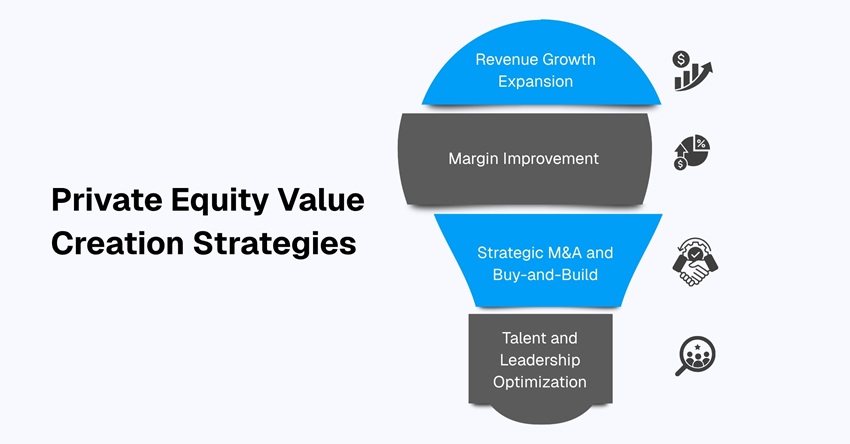
Sustained revenue growth is the most direct driver of enterprise value improvement at exit.
PE firms commonly pursue:
-
Geographic expansion to enter new regional or international markets to increase customer reach.
-
New product launches to introduce complementary products or services to diversify revenue streams.
-
Cross-selling opportunities to offer additional services to existing customers to improve customer lifetime value.
-
Optimizing pricing models strategically to improve margins without reducing demand.
-
Subscription-based revenue models for creating recurring revenue streams that improve predictability and valuation.
For example, a healthcare software company acquired by a PE sponsor may expand into adjacent markets while introducing recurring SaaS pricing structures, thereby improving valuation multiples.
Pricing optimization has become especially important in inflationary markets. Even small pricing improvements can significantly affect EBITDA margins.
Cost efficiency remains essential, but modern firms focus on sustainable optimization rather than aggressive short-term cuts.
Typical initiatives include:
-
Procurement consolidation: Combining supplier contracts to negotiate better pricing and reduce purchasing costs.
-
Lean manufacturing: Eliminating operational waste to improve productivity and efficiency.
-
Shared service models: Centralizing functions like HR or finance to lower administrative costs.
-
Workflow automation: Using technology to reduce manual processes and improve operational speed.
-
Inventory management improvements: Optimizing stock levels to reduce holding costs and improve cash flow.
For example, a PE-backed logistics company may reduce transportation costs using AI-based route optimization systems while simultaneously improving delivery performance.
-
Strategic M&A and Buy-and-Build
Under this approach, a PE firm acquires a platform company and then purchases smaller complementary businesses to expand scale and market share in fragmented industries.
Benefits include:
-
Combining operations to reduce overlapping costs and improve efficiency.
-
Accessing new customer segments through acquired businesses.
-
Increasing market influence to improve pricing flexibility and margins.
-
Consolidating fragmented markets to strengthen competitive positioning.
-
Building larger, more scalable businesses that attract premium buyers.
For example, many PE firms have consolidated regional healthcare clinics or IT service providers through serial acquisitions.
-
Talent and Leadership Optimization
Leadership quality directly impacts portfolio performance.
PE firms frequently:
-
Replace underperforming leadership teams to improve strategic execution.
-
Link management compensation to EBITDA and operational targets.
-
Hire experienced professionals with sector-specific expertise.
-
Strengthen accountability and decision-making frameworks.
-
Encourage operational discipline and measurable business outcomes.
The quality of management execution often determines whether operational improvements succeed or fail. This is why many firms conduct leadership assessments within the first 100 days after acquisition.
Real-World Example of How Private Equity Value Creation Strategies Work in Practice
EQT and IFS: Product-Led Digital Transformation
EQT acquired enterprise software provider IFS for approximately EUR 900 million in 2015. The company was profitable but stagnant, constrained by legacy on-premises software delivery.
Rather than financial engineering, EQT’s strategy was fundamentally operational. The firm funded a complete product transition from licensed software to cloud-based subscription models. This required rewriting core technology, rebuilding sales processes, and reshaping organizational structure. By 2024, revenues exceeded EUR 1.2 billion. A partial stake sale in 2025 valued IFS at over EUR 15 billion, a 17-times entry multiple.
The value came from execution. EQT systematically addressed every operational lever: product innovation (cloud migration), market expansion (deepening enterprise customer relationships), and organizational transformation (new go-to-market structure). This illustrates how value creation in private equity increasingly depends on sustained functional execution rather than favorable market conditions.
Conclusion
Operational excellence has become the primary driver of returns in private equity. Debt and growth remain important but play a secondary role. Leading firms have developed systematic value creation frameworks that they apply consistently across portfolio companies.
Investors should look at a firm’s ability to manage and evolve its business, not just its past profits. Private equity has shifted toward active asset management oriented around long-term value generation.