Introduction
A company’s liquidity often serves as a clearer lens into its operational discipline than revenue figures alone. The net working capital is the balance in the resources at hand to conduct daily operations and those that are to be paid off in the short term. Analysts frequently examine the change in the net working capital formula to identify shifts in operational funding needs. A proper understanding of how working capital changes affect the balance sheet will enable the conversion of balance sheet changes into meaningful indicators of cash efficiency, financial solvency, and the viability of continued business operations.
Net Working Capital in Financial Decision-Making
Liquidity considerations often initiate discussions in boardrooms. Managers review receivables, inventory commitments, and short-term liabilities before approving production schedules or supplier contracts. Net working capital serves as a key financial metric indicating that sufficient short-term resources finance the day-to-day operations. This indicator is regularly used in credit assessment, internal budgeting, and operational forecasting as it relates the balance sheet activity to the availability of cash. The shift in the net working capital formula will help analysts decide whether the expansion of the operations is consuming liquidity or emitting cash into the business cycle. According to the 2025 U.S. Working Capital Survey by The Hackett Group, large companies have about 1.7 trillion USD in surplus working capital, demonstrating the extent of liquidity tied up in operations.
Finance teams interpret working capital signals through several operational lenses.
-
Turnover and supply continuity in inventory.
-
Collection discipline of the receivables.
-
Supplier payment systems.
-
Liquidity buffers on a short-term basis.
Each factor changes the frequency of the movement of cash operations. Investment planning typically reflects these liquidity signals. Working capital tightens the scrutiny of expansion proposals, procurement decisions, and credit extensions. Analysts thus combine operational measures and calculations that explain how changes in working capital can be calculated so that decision makers can determine the feasibility of their growth plans in the changing liquidity environment.
Financial Components That Drive Changes in Working Capital
Inventory levels often provide the first indication of a change in working capital. Before generating revenue, raw materials, work-in-progress, and finished goods to tie up cash. In case of stocking inventory by companies to cope with supply disruption or seasonal demand, liquidity is tied to goods not sold. Receivables create another layer of pressure. The growth in revenue on credit increases the operating cycle, as it postpones cash inflow. The efficiency of capital circulation in day-to-day operations is therefore decided by a balance between the collection of receivables and inventory turnover. These two factors have been noted a lot in financial studies as the operational drivers that increase or decrease net working capital between accounting periods.
The speed of collecting accounts receivable is as important as the sales volume. Delays in paying the customer lengthen the cash conversion cycle and raise the amount of capital necessary to operate.
The terms of payment to suppliers are the other side of the equation. Accounts payable enable the companies to hold on to cash in the meantime as obligations are pending. Increasing the payment terms has the ability to enhance liquidity, but too much delay can put strain on the supplier’s relationships or credit terms.
According to the PwC Working Capital Study 25/26, the global Days Payable Outstanding has been rising 11.5 percent since 2015, as companies are turning to longer supplier payment periods to stabilize their liquidity.
Are You Ready for a Private Equity Career?
Evaluate your knowledge and uncover areas to improve.
Take the Assessment
Step-by-Step Guide on How to Calculate Change in Working Capital
Comparative balance sheet analysis often reveals changes in operations that are not easily revealed in terms of revenue or profits. Financial professionals track such changes by the change in net working capital formula, which is a computation that determines how much the current assets and current liabilities change over periods of reporting. This computation assists in determining whether routine commercial activity is immobilizing liquidity or liberating cash suitable for reinvestment into operations. The movement is usually affected by the expansion of inventory, extended collections of receivables, or changed supplier payment terms. Analysts, therefore, focus on changes in working capital over a period instead of using a single fixed figure when evaluating operational efficiency.
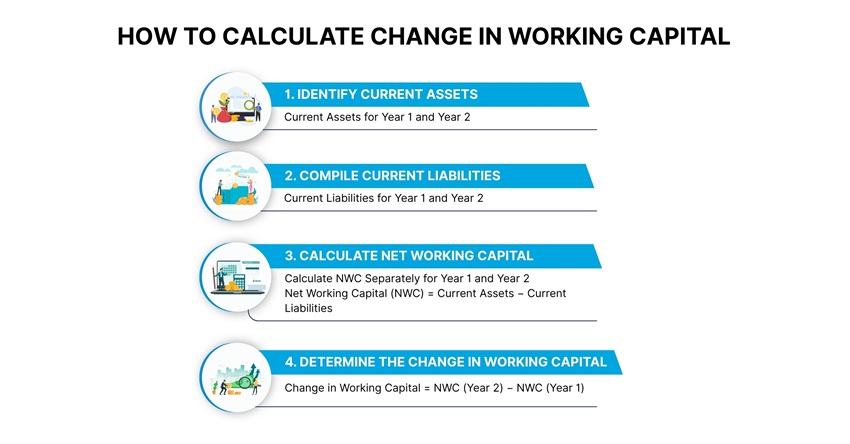
The calculation process itself is straightforward and relies on consistent balance sheet data. The following steps explain how to calculate change in working capital using two reporting periods.
1. Identify current assets for the two reporting periods
Extract balances of accounts receivable, inventory, short-term investments, and other liquid assets in each balance sheet. Using the same type of assets will make the comparison represent changes in operations and not a difference in classification.
2. Compile current liabilities from the same periods
Record balances, including accounts payable, accrued operating expenses, and short-term obligations. These obligations directly affect the calculation of net working capital since supplier credit policies and payment terms impact the short-term liquidity.
3. Calculate net working capital for each period
Calculate the difference between current liabilities and assets of each reporting period. The resulting figures are all the positions of the company as far as its operational liquidity is concerned at that particular time.
4. Measure the difference between the two working capital values
Deduct the net working capital of the previous period from that of the current period. This last comparison brings the calculation of the change in working capital to completion, either showing that the operations have bound more capital to the business or that it has been able to release some liquidity back into the business.
After determining the numerical change, the analysis becomes more than the computation. Financial professionals then look at the functional motives of the change. The next section explains what the changes observed in the net working capital can tell us about both liquidity management and financial performance in general.
Interpreting the Change in Net Working Capital Formula in Financial Analysis
Liquidity measures reveal their actual meaning when the context of operations is examined critically. The outcomes of the calculation of the change in the working capital often indicate changes in the balance between receivables, inventory, and payables in the day-to-day business operations. The growth can be a sign of accumulating inventory or long customer credit periods in the growth periods, and the reverse is also true. Analysts therefore take the result together with the growth in revenues, operating cash flow, and inventory turnover as opposed to taking the direction of the change.
These shifts will be more meaningful when analyzed by analysts on the operational drivers that support them.
Prolonged growth, as indicated by the variation in the net working capital formula, might indicate growth in operation, whereby the increase in receivables and inventory is faster compared to the increase in payables. These tendencies appear in high-growth periods and can temporarily restrict liquidity until the conversion of sales into cash through collections.
Analysts often use the results of operating cash flow trends and the cash conversion cycle to determine whether liquidity is moving due to operational efficiency improvements or if there is a short-term strain from sluggish collections and stock holding.
The outcome of working-capital movement is a measure of financial flexibility or an indicator of liquidity constraint, which is all dependent on context. Based on this, analysts consider changes in the net working capital formula and operational indices such as revenue trends, credit-policy changes, and supply-chain conditions to make a balanced judgment of the short-term financial performance.
Strategic Implications of Working Capital Changes for Business Performance
The working capital flows indicate more fundamental operational changes in procurement, credit, and inventory planning. Financial leaders look at changes found in the change in the working capital to ascertain whether the operational activity is consolidating the liquidity or consuming the cash faster than expected.
Strategic interpretation of these changes affects various business decisions. Growth in working capital can suggest inventory accumulation or a decrease in the rate of receivable turnover, whereas a fall may signify a higher level of operational efficiency or a reduction in the cash conversion cycle. Working capital movement should therefore be seen as an early warning of liquidity strain and discipline of operation by finance teams and not a mere accounting product.
-
Decisions made in capital allocation are guided by findings based on how to compute the change in working capital, particularly at the time when organizations are considering whether operational growth is consuming more liquidity faster than the cash inflows can sustain it.
-
Credit management policies change based on variations in the net working capital formula, as longer receivable cycles may silently undermine short-term financial flexibility despite seemingly high revenue growth.
-
Supply chain financing approaches often react to working capital changes, with procurement departments reviewing supplier payment terms and inventory ordering cycles to avoid having idle cash tied up in working processes.
-
Long-term resilience is reinforced in cases where finance leaders incorporate findings on how to compute the change in working capital into forecasting models, enabling them to predict liquidity strain during the growth phases, seasonal demand fluctuations, or short-term disruption of supply chains.
The working capital trends are monitored on a regular basis, which promotes greater financial discipline within the departments. Reviewing the change in working capital with revenue, inventory turnover, and receivable cycles allows operational managers, treasury teams, and finance professionals to have a better view of liquidity movement. This combined view enables organizations to sustain operational momentum and safeguard short-term financial stability.
Conclusion
The net working capital shows the efficiency of the company to utilize short-term resources and keep the business running. The use of net working capital formula to calculate the change in the net working capital enables the finance professionals to be able to trace the flow of liquidity between reporting periods, as well as to be able to relate operational decisions to cash availability. When organizations know how to compute the change in the working capital, they can interpret the changes in the receivables, inventory, and payables more accurately, contributing to disciplined planning, robust cash management, and more accurate financial analysis.