Introduction
Scale has been the correlate of capital allocation at the high end of large cap private equity markets. Large-cap private equity now exists in a world where volume is less important than accuracy, quality of governance, and detail of execution. Increased capital commitments attract more scrutiny from both the investors and the management teams. It is against this background that large-cap private equity funds are tightening their focus on how they pursue growth, risk management, and position assets in the face of signals emanating out of large cap stocks worldwide.
Capital Concentration and the Redefinition of Opportunity Sets
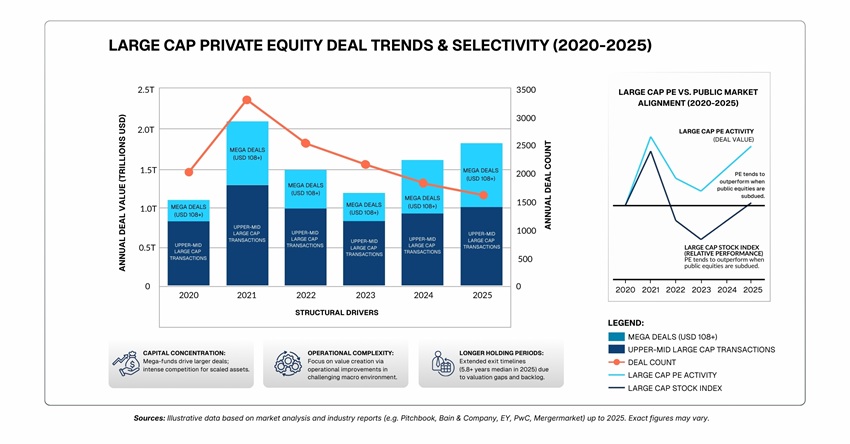
Fundraising in 2025 exemplified how the capital concentration is transforming and how large-cap PE participants are conducting deals and competitive marketing. The biggest funds are occupying an excessive proportion of investor commitments. According to the PitchBook 2025 private equity outlook, the 10 largest funds raised almost 46 percent of the total capital raised this year. It implies that nearly half of the total capital raised is now allocated to a few proven managers.
This change affects the opportunity set in various aspects; big funds tend to focus on fewer deals due to the sheer size of capital that they need to invest. There is an increasingly strict underwriting and diligence process, especially in cases where enterprise values are above the normal billion-plus buyout price. Meanwhile, sponsors can negotiate better conditions with sellers due to their faster and more reliable deal execution. Limited partners (LPs) are reacting to fundraising terms by scrutinizing managers more harshly and tending to make investments in managers who have a good performance track record and whose strategies are differentiated.
The implications for deal activity are visible across the market:
-
More capital under management enables undertaking complex transactions and carve-outs that smaller investors cannot.
-
The concentrated capital flows cause the number of bidders in smaller buyouts to go down, and in many cases, it drives down valuations in those segments.
-
Selectivity puts more pressure on managers to provide quality pipelines rather than cash deployment capability.
Operating Depth as a Differentiator at the Upper End of the Market
Investors in large-cap private equity funds are placing an increased emphasis on profound operational experience. Conventional methods, which were once heavily reliant on financial engineering, no longer impact returns as much as macroeconomic pressure and tightening debt markets demand physical improvements within portfolio firms. According to the PE Value Creation 2025 by Simon-Kucher, 33 percent of deal teams and operating partners mention operational improvements as the most common source of equity performance, higher than any other value lever in the study.
The implications in practice are obvious. Seasoned operating partners and specialists are being integrated into the investment processes of sponsors at an early stage. These professionals are concerned with discipline in prices, cost-effectiveness, and revenue maximization in diligence and throughout ownership. The ability to execute is what can translate a flat financial return to one that is at or above the target internal rates of return. Since such efforts impact earnings before interest and taxes, the portfolio companies become more resilient to external shocks and financing volatility thanks to efforts by experienced operators.
Compare this practice to a more passive strategy in which there is restricted operational involvement, with performance largely being tied to market cycles. When this happens, the returns may vary considerably with changes in the economy. Operating depth minimizes that variability by harmonizing the management incentives, narrowing the performance measures, and establishing operational milestones that are measurable and contribute towards growing the valuation.
Practically, the funds that develop genuine operational engagement show better results upon exit. Strategic execution has become as important as capital in how large-cap private equity firms differentiate themselves in 2026. Board oversight, active performance tracking, and structured post-deal playbooks are now becoming the norm.
Portfolio Construction in an Era of Fewer, Larger Bets
Portfolio design within large cap private equity increasingly reflects conviction rather than breadth. Concentrated allocations give more emphasis on judgment, sequencing, and execution discipline, as each investment has a significant impact on the overall fund performance. It has been focused on creating fewer jobs that can absorb long-term attention, capital, and effort in operation without having to dilute risk at the portfolio level.
-
Capital is invested in a strategically restricted set of holdings in large cap private equity portfolios, elevating the requirements of underwriting rigor and compelling sponsors to analyze downside sustainability, management believability, governance preparedness, and strategic optionality more than conventional valuation and leverage indicators.
-
The concentration transforms risk oversight by substituting passive diversification with active oversight, in which ongoing monitoring, downside scenario planning, and prompt corrective intervention become the focal points in safeguarding aggregate fund performance.
-
Exit planning is built into the construction of portfolio, as smaller the number of assets, the more explicit the realization pathways that may operate under diverse market regimes rather than those provided by opportune timing or general liquidity cycles.
-
Portfolio pacing is a structural choice and not an execution detail because the timing of capital deployment and the supply of follow-on reserves are directly connected to exposure balance across vintages and macroeconomic phases.
Alignment Pressures Across Investors, Managers, and Management Teams
The movement in the performance of public equity is becoming a key factor in determining the assumptions of valuation and strategic decision-making in large-cap-based transactions in the private equity market. The comparative level of changes in enterprise values between the public and private markets is one of the obvious signposts. According to the Q2 2025 Lincoln Private Market Index, privately owned companies experienced a 2.5 percent rise in enterprise value in the second quarter of 2025, whereas the public markets, as measured by the S&P 500 enterprise value, saw a 10.6 percent increase in the same quarter. This deviation shows that the multiple expansion has been more of a driver in the public markets, but the underlying growth in earnings has been steadier in the private markets.
Such a comparison is important in determining the pricing standards of potential assets. Public multiples are used by sponsors to determine whether the private targets are trading at a premium or discount to larger market indicators. During times when the market is having a high valuation increase, large-cap private equity fund bids can require more underwriting restraint, since public expectations on returns become more constrained and investors begin to compare hypothetical public options more closely. The volatility of the public equity signals is also followed by fund managers, as it determines the timing of exit and secondary selling enthusiasm. A sustained high growth in public indexes can indicate an opportune time to actualize, and when there are quiet periods of public performance, then the emphasis can be placed on a longer investment period and operation enhancement in portfolio companies.
-
Valuation comparison as a reference trigger
Sponsors optimize their bidding strategies to prevent overpayment when there is a difference between growth in the enterprise value in the public market and the private market. They also vary the expected internal rates of return by taking into account the impact of the public multiple expansion on the exit expectations and test the private returns against the overall index behavior.
-
Market sentiment’s role in deal activity timing
The trend in public equity can be used to determine the timing of large-cap private equity sponsors to expedite or postpone the execution of deals. In case the risk-off behavior is indicated by public indices, sponsors can slow down deployment in order to retain optionality, and in more favorable or increasing markets, they can time investment to enter into more favorable exit conditions.
Conclusion
The present trend of large-cap private equity is an accentuated compromise of size and restraint. Higher platforms are making fewer but more deliberate commitments, backed by greater operating engagement and more cohesive stakeholder alignment. Large-cap stock signals are still significant in valuation discipline and exit planning, and large-cap private equity funds support their position as long-term owners designed to be complex and not volume-oriented.