Introduction
Private equity currently holds substantial committed capital that remains untapped. Dry powder refers to the portion of committed capital that remains available for investment. However, not all uncalled capital is necessarily available for new investments, as some may be reserved for follow-on investments or other fund-level requirements.
At the start of 2026, global PE dry powder climbed to roughly USD 3.7 trillion. That is nearly double the 2019 level, as reported by PipelineRoad, based on Preqin data.
By itself, this figure reveals little. What matters more is how dry powder in private equity influences a fund manager’s ability to raise their next fund, how it affects the timing of investment decisions, and shapes how investors evaluate a manager’s performance and deployment discipline.
What Is Dry Powder in Private Equity?
Most definitions describe dry powder as money investors have committed to a fund that the manager hasn’t formally called yet. The distinction is simple to state but runs deeper. Total fund commitments cover everything a manager can eventually raise and spend over the fund’s life. Dry powder represents the committed capital yet to be deployed following a capital call.
People also confuse it with related terms that mean something else. Assets under management (AUM) already include capital that has been deployed, so a fund can post a large AUM number while holding very little unspent reserve. Callable credit lines and subscription facilities let a General Partner (GP) bridge a deal before formally calling Limited Partner (LP) money, which means some transactions close using capital that technically never counted as dry powder at the time. Then there is reserved follow-on capital, money set aside for existing portfolio companies rather than new deals, which shrinks the picture even further.
The mechanics remain straightforward. A GP spots an opportunity, sends out a capital call, and LPs wire their share within a window laid out in the fund’s agreement, usually business da10-15ys. That lag, plus limited partnership terms and investment period deadlines, is why dry powder behaves more like callable capacity than idle capital.
Strategy plays into this too. Buyout funds alone were sitting on about USD 1.3 trillion in dry powder as of early 2026, per Bain & Company’s Global Private Equity Report 2026. Growth equity, venture, and private credit each runs on their own deployment clocks, so lumping everything into one aggregate figure tends to hide distinctions that matter when evaluating a specific manager.
The Fund Formation Cycle and Capital Accumulation Pressure
A general partner sitting on a large unspent reserve from its current fund rarely has an easy time raising the next one. Limited partners have gotten pointed about this during due diligence, asking outright how much capital a manager is still carrying before they will commit to a new vehicle. It is not a throwaway question.
Distributions back to LPs, measured as a share of net asset value, have stayed under 15 percent for four years running. This is an industry record as reported in Bain’s 2026 report. When cash stops flowing back, allocators naturally get pickier about where fresh commitments go.
That caution shows up structurally too, in what institutional investors call the denominator effect. Pension funds and endowments build pacing models to figure out how much fresh commitment capacity they’ve got left across their private markets book, and existing dry powder exposure weighs heavily in those calculations. A portfolio already stacked with uncalled commitments from earlier vintages just doesn’t have as much room left for a new one.
Fund sizing follows the same reasoning. Target sizes and hard caps are increasingly built around realistic deployment capacity rather than pure fundraising ambition, since a GP that raises more than it can sensibly put to work within its investment period invites exactly the scrutiny described above. Re-up decisions carry this step further. When existing LPs weigh whether to back a manager’s next fund, they treat unspent capital from the current one as its own standalone factor, separate from performance or how the broader market is doing.
Deployment Pacing and the Discipline of Deal Timing
Large reserves can create significant pressure to deploy capital over time. Investment-period deadlines, usually running 3-5 years, can push managers toward investment activity even when market pricing is less attractive. This pressure can influence entry multiples and deal selection, potentially affecting overall investment discipline.
Once the signals are identified, the gap between disciplined and rushed deployment becomes obvious.
-
Disciplined deployment leans on patient sourcing and valuation sensitivity. It is comfortable letting a deadline creep closer rather than forcing a mediocre deal.
-
Rushed deployment can sometimes be associated with pressure to invest capital within a fund’s investment period. Management of fee structures based on committed capital may also influence incentives around deployment, although investment decisions are shaped by a range of factors, including market conditions, fund strategy, and available opportunities.
Dry powder can also provide a strategic advantage. Firms with substantial reserves can move quickly during market dislocations, distressed situations, or take-private opportunities, particularly when competitors with limited available capital are unable to respond quickly. That optionality is part of why allocators tolerate elevated reserves in the first place, so long as the manager can explain the thinking behind holding them.
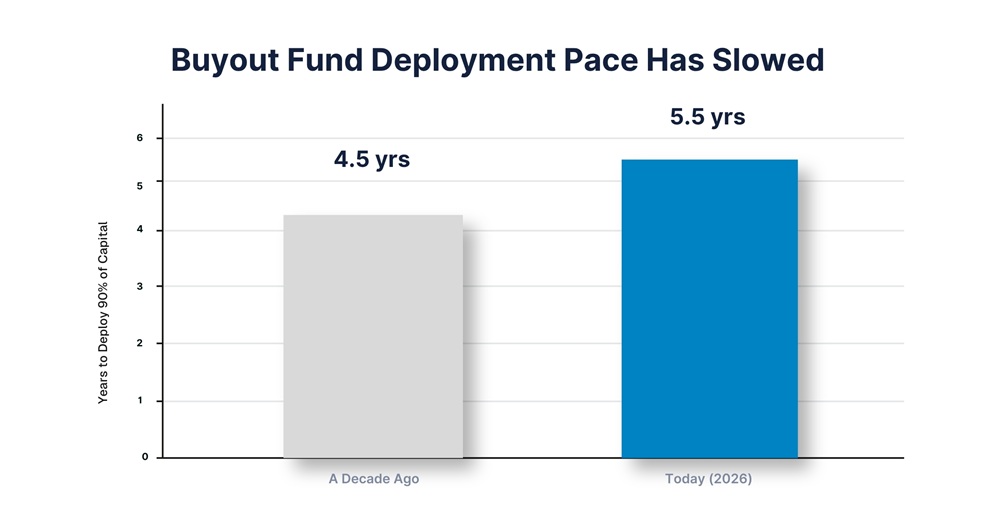
Private equity funds are taking longer to deploy their capital. The average buyout fund now takes 5.5 years to deploy 90 percent of its capital, up from 4.5 years a decade ago, based on PipelineRoad’s 2026 dry powder analysis.
Reading Dry Powder Trends as a Market Signal
Aggregate reserve levels work as a rough gauge of broader conditions. High dry powder paired with slow deployment usually points to a gap between what buyers are willing to pay and what sellers want, higher financing costs, or plain old macro uncertainty, not a shortage of capital itself.
That gap has piled up into a real liquidity backlog. The industry is currently holding roughly 32,000 unsold portfolio companies worth an estimated USD 3.8 trillion, with average holding periods now stretching close to seven years, up from five to six years between 2010 and 2021, as shown in Bain’s 2026 Report. Interest rate cycles and exit market activity sit near the center of all this, since cheaper financing and reopened exit routes tend to speed up how quickly committed capital turns into finished deals.
Prolonged overhangs compress return expectations. More capital chasing a limited pool of quality assets tends to push entry prices up, eating into the multiple expansion managers used to lean on for part of their returns.
Geography adds one more layer worth noting. North America, Europe, and Asia-Pacific show meaningfully different overhang and deployment patterns depending on regional financing conditions, exit market depth, and fundraising momentum. That is exactly why treating dry powder as a single global figure tends to hide more than it reveals.
What Sophisticated Investors Look for When Evaluating Managers
Allocators have turned deployment behavior into a formal diligence category, not just a passing observation. A handful of signals keep showing up across institutional evaluation frameworks:
-
Deployment pace measured against peer benchmarks within the same vintage year
-
Vintage-year diversification across a manager’s overall portfolio exposure
-
Consistency between a fund’s stated strategy and how its capital has actually been used
-
The explanation a manager gives for reserves sitting above typical levels for a fund’s age
General partners have adjusted how they communicate as a result, walking LPs through deployment plans and capital velocity in investor updates well before anyone has to ask. That proactive approach tends to build confidence, while a lack of explanation invites scrutiny.
The reputational stakes are real here. A manager carrying persistently high uncalled capital late into a fund’s life faces tougher questions than one showing steady, strategy-aligned deployment. Meanwhile, 74 percent of limited partners now expect liquidity pressure to shape their strategy this year, according to Adams Street Partners’ 2026 Global Investor Survey. Placement agents and investment consultants include dry powder benchmarking in the evaluation frameworks they use when advising institutional investment committees. It carries weight in the due diligence process from the start.
Conclusion
Dry powder functions as an active indicator within private equity. It influences fundraising discussions, provides insight into deployment discipline, and directly affects how limited partners decide where to make their next commitment.
Context is really what separates a useful reading of the term from a misleading one. Structural limits, investment-period timing, and market-wide signaling all sit underneath the headline number, and managers who can explain where they stand within that context tend to fare better than those who just point to the total. Disciplined deployment is likely to remain the sharper predictor of which managers keep earning LP trust, more so than the size of the reserve itself.