Introduction
A well-structured due diligence checklist sits at the center of disciplined business acquisitions. Buyers use it to distinguish between facade performance and underlying reality, factors that determine value, risk, and continuity. Instead of being a procedural process, this checklist, when purchasing a business, serves as an analytical framework, directing the examination in the areas of financial integrity, operational strength, and legal vulnerability. It enhances decision-making and minimizes uncertainty when done strictly before the transfer of ownership.
Strategic and Commercial Fit Assessment
Evaluating the suitability of a target business to your strategic objectives is not about the numbers only. An effective due diligence checklist should examine the presence in the market, customer concentration, competitive sustainability, and expansion prospects to determine whether the acquisition will strengthen your business model. According to Harvard Business Review, deals where strategic fit was prioritized showed a 30 percent higher success rate compared to those that ignored it.
Begin by considering the complementary or expanding nature of the target products or services to your products or services. Look at the customer concentration so that there is no over-dependence on a few accounts. Consider competitors and entry barriers. Business resiliency is also essential; consistent income and certain retention rates tend to indicate a more balanced fit. After knowing these factors, you are able to determine whether the acquisition benefits your reach and future path. This is also a step to determine the areas that should be further investigated in terms of operations or finances before proceeding with the process to purchase a business.
Financial Review and Earnings Quality
An essential element of any due diligence list when purchasing a business is the financial analysis and evaluation of the quality of earnings. Successful purchasers do not just consider the headline profits but go further and see which part of the earnings are sustainable and reproducible. In many cases, high earnings may be supported by transient accruals or accounting techniques that will vanish once the acquisition is consummated.
A quality of earnings assessment is one of the analytical lenses. This puts emphasis on the motivations of reported income by isolating recurring operating results and unusual or non-operating items. This kind of analysis is important for practical results. Recent market research indicates that the activity in global mergers and acquisitions remained strong in 2025, with 726 deals being done and the buyers reducing the performance gap between those who did not take part in deals and those who did to only -0.5 percentage points, meaning that the buyer is expected to perform better as diligence increases.
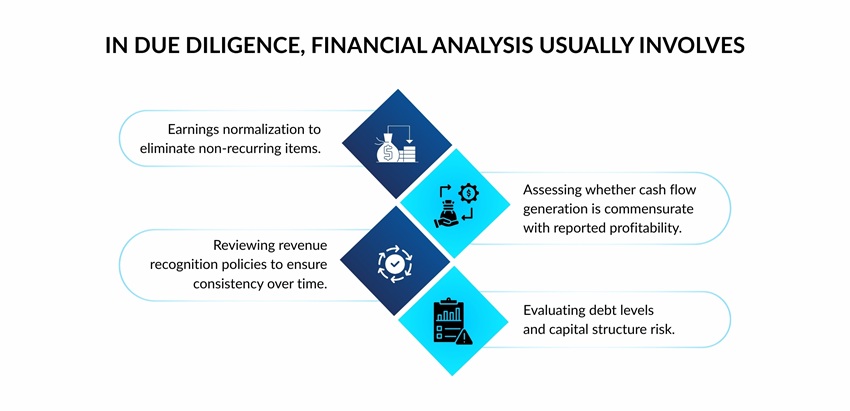
In due diligence, financial analysis usually involves:
-
Earnings normalization to eliminate non-recurring items.
-
Determining whether cash flow generation is commensurate with reported profitability.
-
Checking revenue recognition policies to ensure uniformity over time.
-
Evaluation of debt and capital structure risk.
Such financial analysis helps purchasers understand past performance and anticipate future challenges. Disciplined thinking can have an impact on valuation, negotiating deal terms, and determining financing strategy in a fashion that the price paid will be a true measure of the economic strength of a company and not an accounting phenomenon.
Applying a Due Diligence Checklist in a Mid-Market Acquisition
A strategic buyer used a structured due diligence checklist to acquire a technology services company, resulting in a successful mid-market acquisition. Early diligence emphasized earnings quality and cash flow sustainability as opposed to superficial growth in revenues. This strategy is consistent with the results of the Deloitte 2026 M&A Trends Survey, which states that 90 percent of the respondents predict a growth in transaction volume within the next 12 months, increasing competition and raising the price of diligence mistakes. The research highlights the reason why buyers increasingly prioritize the validation of recurring earnings and the transfer of risk before the finalization of pricing decisions.
-
Material dependence on non-recurring streams of income through historical performance was determined through financial diligence. Consequently, the buyer changed assumptions on valuations, added working capital true-ups, and negotiated seller indemnities to reduce post-close earnings volatility exposure. The adjustments were recorded in the larger due diligence checklist, which is to ensure that the reported performance and sustainable cash generation are aligned.
-
Technology and operational reviews identified the risks of executing the process related to legacy systems and the inadequate number of internal controls. The buyer added milestones of phased integration and deferred consideration, which enables the operational remediation to be completed in advance of full value transfer, as well as the diminishing downside risk of the transition period.
After the closing, the transaction continued with reduced integration interruptions and greater lender confidence.
The case illustrates the role of a disciplined due diligence in serving as a framework of decision-making as opposed to a procedural exercise, especially in competitive deal situations.
Operational, Technology, and Human Capital Review
The success or failure of an acquisition is a frequent occurrence, and this usually happens many years after the acquisition is finalized, depending on the effectiveness of day-to-day operations in new hands. Operational review focuses on the manner in which work is done and not the way it is presented in presentations. Close attention should be paid to process dependencies, supplier concentration, inventory discipline, and capacity constraints. The margins may be eroded by small inefficiencies when multiplied. The buyers must also evaluate the ability of existing operating models to absorb growth and not introduce friction or risk of execution.
Technology review must have a practical prism. The systems can be operational today, yet restrain the ability to integrate, report, or automate in the future. The precision of data, the stability of the system, the protection of cybersecurity, and the dependency on the vendor are to be considered as a united set. Older infrastructure or disjointed platforms may bring cost and complexity, which only become evident after migration. This sector is prone to unnoticed investment needs that have significant impacts on the returns after closing.
Human capital diligence is concerned with continuity and ability. The extent of leadership, the pattern of employee turnover, and aligning incentives determine the level of smooth transition of the business.
Areas that typically warrant closer review include
-
Dependence on a small group of decision-makers.
-
Institutional knowledge is tied to informal processes.
-
Cultural readiness for operational change.
Taken together, these insights ground the evaluation process in execution reality, helping buyers anticipate operational strain before it becomes an ownership problem.
Conclusion
Successful acquisition decisions are based on rigorous assessment instead of intuition. A properly organized process transforms the ambiguity of information into a certain judgment and enables buyers to test assumptions, identify liabilities, and ensure long-term feasibility. A due diligence checklist to purchase a business, when implemented consistently, has turned into an implementation framework to support the evidence-based, transparent, and sustainable value creation in ownership change across various transaction scenarios across industries.
FAQs
Why is a due diligence checklist important?
It helps ensure that all critical financial, legal, operational, and commercial aspects of a business are reviewed before making a transaction decision, reducing potential risks, and uncovering hidden liabilities.
Is the due diligence checklist the same for every transaction?
No. While core sections are common, the checklist is often customized based on the industry, transaction size, regulatory requirements, and the specific risks associated with the target company.
What legal risks can be identified through due diligence?
Due diligence helps identify potential legal risks before a transaction is completed. These may include ongoing lawsuits, regulatory non-compliance, intellectual property disputes, unclear ownership of assets, and unfavorable contracts. Identifying these issues early allows buyers or investors to assess risk and adjust deal terms if necessary.
What are the most common mistakes companies make during due diligence?
The most common mistake is poor preparation of documents and information. Companies sometimes provide incomplete data, overlook legal or compliance issues, or fail to organize documents properly. These issues can slow the process and raise concerns for investors or buyers. Using a structured due diligence checklist helps reduce these problems.