Introduction
The increasing popularity of family offices as private equity participants indicates a shift toward more conscious management of long-term wealth. Families are creating internal teams, gaining deeper sector knowledge, and taking ownership in a more disciplined form that has previously been linked only with big institutions. This will enable them to move with speed, design and implement their strategies locally, and match capital with the multigenerational priorities. Family office private equity investing is an indication of a larger shift toward more agile, stewardship-oriented, and
long-term value creation of investment models.
The Strategic Appeal of Direct Ownership
Family offices that have direct involvement in private companies have even greater control over how capital is deployed and the investment duration. The families are able to create investment and value creation plans aligned with their priorities and sector expertise and have closer control over the decisions that affect returns. This strategy also supports intergenerational alignment by establishing targets and management benchmarks internally rather than relying on external fund structures.
-
Direct ownership will enable families to select management teams, negotiate terms of governance, and create incentive schemes that suit their long-term goals rather than fund pre-established rules.
-
Unusual deal structures, such as minority investments or multi-party deals, can be used to balance concentrated exposure and support opportunities that appeal to the beliefs of the family office by investing in private equity.
-
The patience in holding periods will enable families to remain invested in the market amidst changes, accommodate operational changes at a gradual rate, and realize value that might take time to manifest.
Gain deeper perspective on private markets, governance, and investment strategy with USPEC.
Subscribe Now
Flexibility That Traditional Investors Struggle to Match
The structures of these families allow them to have agile decision-making processes and have the liberty to make deals, as they are not bound by the template of big institutional investors. They do not have to go through various committees to green-light transactions by their internal teams. This flexibility is particularly useful in middle-market deals, where time frequently is basically the difference between a successful and a failed deal.
Family offices are not tied to normal fund patterns, which means that they can invest long enough to enjoy transformational growth. This may involve waiting for a company to complete a restructuring or investing in a comprehensive operational overhaul, including technology and supply-chain improvements.
-
They frequently enter into negotiated deal structures in the form of committed stage capital, minority investments with active management, or non-standardized payout structures. These approaches allow them to participate in founder-led companies or non-standard forms of structure that large institutions do not.
-
There is increased efficiency. When families carry domain knowledge, they are positioned to assess niche sectors, and thus, can invest in complex or specialized industries in which market trends have not yet capture long-term potential.
-
Prolonged holding periods provide families with the time to invest in gradual
value-creating programs instead of pursuing quick gains.
According to a 2025 report by Goldman Sachs, nearly 40 percent of family offices surveyed intend to increase their investment in private equity in the next 12 months, and there is an increasing interest in direct or flexible private-market involvement. That is a general direction. Family offices appreciate the flexibility of making deals on their own schedule, on their own terms, with a long-term outlook.
Access to Niche Sectors Fueled by Expertise and Networks
The families that depend on family office strategies of private equity are increasingly investing in areas where the families have a natural advantage through their expertise and connections. Value commonly overlooked by broad-based funds can be evident to sector experts in renewable infrastructure, health innovation, specialty manufacturing, and
technology-enabled services, particularly in founder-led or regional businesses. This is a narrowly focused strategy that occasionally gears up business acumen and patient capital.
-
Most family offices use operating executives, their peer groups, and their long-term banking relationships to access off-market deals to utilize the access to craft structures that capture subtle risk, succession, and growth relationships.
-
According to the Citi Wealth 2025 Global Family Office Report, a global survey of 346 family offices, each with an average net worth of USD 2.1bn, revealed that 36 percent of surveyed family offices have been adding to privately invested portfolios over the last year, with only 10 percent decreasing this amount, indicating the growing popularity of family office-led private equity investing as an entry point into differentiated, more confidential opportunities.
Co-Investment Momentum with PE Funds and Strategic Partners
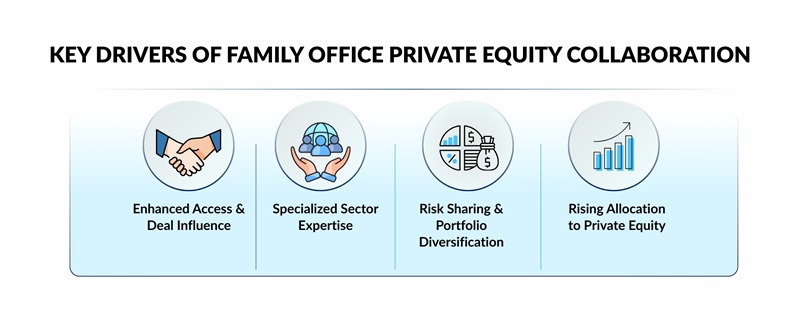
Partnerships have emerged as a strong tool for family office private equity investing. Collaborating with established private equity sponsors, industry participants, and family peers enables access to transactions that would require additional capital, diligence, and expertise, that a single office would not undertake on its own. This change is part of a larger trend towards enhancing the capacity to influence outcomes in competitive deal settings.
-
Co-investing with private equity funds helps families gain access to information and influence to be involved in the decision-making process regarding structuring, oversight, and the timing of exit.
-
Sector-specific partners provide technical depth and operating experience, enhancing the quality of due diligence and assisting in identifying niche opportunities that are not widely marketed.
-
Club structures spread financial risk across many parties, and families can participate in larger deals without jeopardizing the diversification objectives.
-
According to the 2025 Asset Vantage Family Office Private Equity Outlook, private equity now accounts for 43 percent of the average family office portfolio, up from 39 percent in 2023, indicating a clear shift toward collaborative private market strategies.
Investing through partnerships is gradually transforming the way family offices seek opportunities in the field of private equity. These partnerships provide families with a wider reach, better quality insights, and the possibility to share the burden in complicated transactions. As capabilities grow inside modern family offices, co-investment models are
well-positioned to remain a central part of their long-term strategy.
A Shift Toward Professionalization and Institutional-Grade Governance
The operating models of many family offices are being redesigned in such a way that their activity in the private market takes the form and discipline of established institutions. Investment teams have been split into sourcing, diligence, and monitoring teams, and compliance and operational oversight teams. Defined guidelines in the decision rights, documentation, and review cycles can be used to ensure that the private equity strategies remain the same across business cycles and generations. The change will aid greater deal flow, easier coordination with partners, and a better fit between long-term family priorities and day-to-day implementation.
-
The investment policies are designed to outline the manner in which opportunity is filtered, which measures are used to appraise, and how results are measured across various segments of the private market.
-
The investment committees and family councils are given a better person for that, and this eliminates confusion on who determines the strategy and who does the transactions.
-
Reporting systems are also modernized in such a way that teams are able to monitor activity of direct deals,
co-investment, and fund commitments in a single format that is able to support quick and more precise
decision-making.
-
The control functions, such as compliance, audit, and operational risk, become more organized, which guarantees smoother internal coordination and protection in managing multi-entity or cross-border holdings.
This wider professionalization can be seen as an indication of a sustainable long-term commitment to the activity of private equity. It enhances discipline throughout the investment cycle, facilitates more complicated transactions, and assists families in growing responsibly. It also increases the level of expectations about transparency and consistency. Ultimately, these results increased the level of trust between advisors, partners, and future generations.
Conclusion
Family offices' private equity activity is marked by an increase in control, scope, and precision in direct and collaborative transactions. This movement is gaining momentum, with families embracing institutional discipline whilst maintaining the fluidity that makes them stand out. In practice, family office private equity investments influence transactions through longer time horizons, deeper diligence, and a growing emphasis on purpose, strengthening their impact on private markets.