Introduction
Comparisons of investment banking and private equity confuse functions that have vastly different mandates. One of them focuses on ownership and long-term stewardship of capital. The other specializes in advising on transactions that shift markets and balance sheets. Now, when it comes to addressing the question of what private equity and investment banking is, one must go beyond the titles to analyze incentives, authority, and risk exposure. This article describes private equity vs investment banking as having different financial architectures that define the difference in the way value is sourced, measured, and ultimately captured.
What Is Private Equity?
The operations of private equity are based on ownership and not intermediation. Institutional and accredited investors provide firms with committed capital, which they use to obtain significant interests in private firms. The goal focuses on enhancing business performance by strategic control, financial discipline, and operational optimization within a specified holding period.
Compared with investing in a public market, private equity is direct. Investment teams are closely involved with management, with decisions being made based on expansion, cost structure, and capital allocation, and they take on concentrated risk based on long-term results. The value is eventually realized through planned exits, which represent long-term value creation as opposed to short-term transactions.
What Is Investment Banking?
Investment banking is the financial service that assists organizations to raise funds, consult on mergers and acquisitions, and formulate complex transactions. These companies are agents of relationships between issuers of securities and investors, instead of long-term interests in businesses they consult. According to the Mordor Intelligence US Investment Banking Market Size 2026 report, the industry is projected to be worth about USD 56.68 billion in 2026.
Practically, investment bankers collaborate with corporate clients to analyze business strategies, conduct a close financial analysis, and create financial instruments that satisfy funding requirements. They are focused on execution and advisory, and tend to operate within strict deadlines and situations that are high stakes.
This professional field demands critical thinking, excellent interpersonal communication, and opportunity evaluation knowledge in any field. Investment bankers facilitate the movement of capital, which drives corporate growth and economic activity through underwriting, advisory fees, and capital markets activities.
Are You Ready for a Private Equity Career?
Evaluate your knowledge and uncover areas to improve.
Take the Quiz
The Core Distinctions That Shape Each Career Path
Investment banking and private equity have different positions in the financial world, and their impact on business performance is very different. Recent increases in deal value can be considered one tangible indicator of the footprint of private equity. According to the 2026 Global M&A Outlook report, the total value of the global private equity deals increased to approximately 31 percent in 2025 as compared to the previous year, with even greater capital deployment but a decline in exit activity.
The private equity firms put money into companies and become operational directors of these businesses, unlike investment banks, which make fees when purchasing the company, but mostly get the money through fees they charge when giving advice about the transactions. This ownership orientation implies that they tend to strive to enhance performance over a time span of a few years, instead of being the tools that help to complete a single deal.
Investment banks are distinguished by their advisory services and financing. When the market is active, revenue may explode in this space. As an illustration, a 2026 forecast of investment banking fees indicated that the world bankers were projected to receive estimated investment banking fees of USD 9.3 billion in 2025, which is 21 percent higher than the previous year.
Another evident difference is the decision-making authority. The strategic decisions made by professionals in the private equity market relate to long-term decisions concerning portfolio firms in which they have ownership. Investment bankers, on the contrary, are intermediaries, acting to assist corporate clients between options and to make deals without actually owning the assets themselves. This presents a basic distinction in the way every route is formed to the industries and leads to economic development.
Structural and Incentive-Driven Distinctions
-
Privacy equity creates long-term value in ownership, operational transformation, and strategic repositioning.
-
Investment banking makes money through advice on mergers, capital raises, and complicated deals.
-
Compensation models are varied since private equity rewards performance over the long term, whereas the investment banking model rewards deal execution and market conditions.
These variations inherently determine the unfolding of transactions after an opportunity has been uncovered. The ownership, incentives, and responsibility have a direct impact on who makes decisions, risk assessment, and post-deal actions. That comparison is even easier to draw when looking at the fund lifecycle itself and where decision-making power really lies in each of the paths.
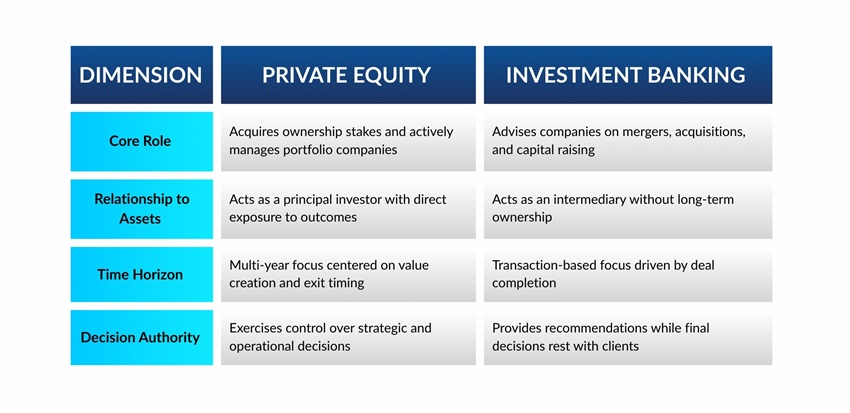
How Deals Unfold and Who Makes the Calls in Private Equity vs. Investment Banking
The transaction process tells a lot about what private equity and investment banking are.
In private equity, the company becomes the acquirer and finances and implements its own investment thesis. Once the potential targets are sourced, teams conduct extensive due diligence, including financial performance, position in the market, and levers of operations. All big decisions go through an internal investment committee, which puts risks and return expectations into consideration. It is required to discipline the long-term value creation by having the approval of this committee before committing capital. A 2026 Deloitte M&A Trends survey found that nearly 90 percent of private equity respondents expect deal activity to rise in the next year, which indicates confidence in the approach.
The lifecycle of a private equity deal is characterized by long appraisal phases as companies haggle on the terms of future strategy, close compatibility, and sophisticated financing structures, possibly with a combination of lenders.
-
The screening is intense and usually based on the potential of operation, scalable benefits, and cultural compatibility as opposed to simple valuation measures. The leadership and the investment committee of the firm have authority in every critical checkpoint.
-
Due diligence focuses on operational preparedness and execution risk, where the sessions are facilitated by the private equity teams, and information flow is managed to shape the way the next thing happens.
Investment banking is different. Firms advise clients on strategy, valuation, and potential buyers, while clients retain final decision-making authority. Bankers facilitate due diligence, integrate market knowledge, and package proposals to be reviewed by boards, but are not custodians of the capital that the transaction is based on.
-
Relationship depth and positioning expertise are the foundation of origination, as opposed to ownership commitment.
-
Due diligence is designed through advisers, where the need of the client is clarity and not internal investment approval.
At closing, private equity will continue to be responsible for performance after the transaction. Investment banks move on after signing a deal, and they do not have any continued ownership rights.
-
The negotiation powers in the private equity remain with the top firm management up to signing.
-
In the investment bank, clients make the bottom-line decisions on the basis of advice.
-
The investing entity, not the adviser, assumes post-closing responsibility.
Skill Architecture and Professional Development
Different business models shape how professionals learn, specialize, and advance, making skill development a direct reflection of how value is created in private equity vs investment banking.
Skill development in private equity or investment banking seldom takes a direct path. Initial paths in both careers begin with a strenuous financial foundation, but the compounding of those abilities is soon different. The investment banking industry emphasizes accuracy when time is a factor, repetition of transactions, and the capacity to convert figures into a format that can be used by the client. The analytical depth of private equity is built more gradually and is connected to the business environment, business operations, and ownership accountability that is not one quarter but a few years.
Training programs in investment banking follow a structured format. Analysts internalize standard procedures, reporting rigidity, and performance work patterns promptly. Reliability, responsiveness, and technical precision at the level of various deals operating concurrently are the indicators of progress.
There are less uniform learning curves in the case of private equity. Exposure spreads due diligence, portfolio performance, and exit strategy, which broadens judgment beyond spreadsheets. Experts have been taught how to relate the assumptions to the actual performance, and they are testing the investment theses by operational realities within portfolio firms.
Interpersonal ability also develops differently. Bankers develop concise communication skills for interactions with senior executives, regulators, and counterparties who demand straightforward communication without wasting time. Private equity professionals spend more time developing trust with management teams and advisors and tend to impact results through long-term relationships rather than through transactional influence.
Feedback systems are also different. The performance reviews used in banking measure the quality of performance and the ability to work as a team, whereas those in private equity focus on the quality of decisions, risk awareness, and long-term value.
Combined, private equity vs investment banking is a skill architecture study. One route is rewarding skills in execution systems. The other develops adaptive thinking that is based on ownership, accountability, and strategic patience.
Conclusion
The distinction between private equity and investment banking is better understood when the differences are put in simple terms. Investment banking revolves around advising, structuring, and executing transactions, whereas private equity revolves around ownership, governance, and creation of long-term value. These models influence the decision authority, skill development, and accountability differently. A clear distinction between private equity and investment banking makes the comparison a decision between transactional influence and long-term operational commitment, which characterizes two different relationships toward capital and risk.
Frequently Asked Questions
Q. Which pays more: Private Equity or Investment Banking?
A. Private equity can offer higher long-term compensation, especially through carried interest in successful funds. However, investment bankers may earn competitive bonuses and high compensation earlier in their careers.
Q. Which has better work-life balance: Private Equity or Investment Banking?
A. Investment banking is generally known for longer and unpredictable working hours. Private equity roles may offer relatively better work-life balance, though hours can still be demanding during active deals.
Q. Is private equity harder to get into than investment banking?
A. Private equity roles are typically more competitive because firms hire fewer professionals and often recruit candidates who already have experience in investment banking, M&A, consulting, or corporate finance.