Introduction
Private markets are placing serious weight behind sustainability, and this shift is altering the metrics used by investors to assess long-term performance. Capital is shifting towards approaches that combine commercial rigor with quantifiable accountability, resulting in ESG private equity gaining a more explicit role in decision-making. Companies are reconsidering risks, improving monitoring, and seeking companies that may grow without compromising on the environment or social norms. This momentum is therefore putting ESG private equity funds and the wider ESG private equity investment practices at the center of the investment process. This shift is accelerating and reshaping the expectations placed on firms, along with commitments investors are now willing to make.
What Drives the Surge in ESG Commitments Among Private Funds
Institutional capital is pushing managers in the private sector to consider sustainability as a need and not a secondary theme. Limited partners question fund conditions and disclosure so that the ESG private equity approaches consider the climate, social, and governance risks in a quantifiable way. The regulatory frameworks on climate reporting and supply-chain reporting are putting strain, and sponsors are finding benefits in having resilient companies. The survey conducted by Morgan Stanley Sustainable Signals 2025 indicates that 84 percent of institutional investors expect that the sustainable assets under management ratio in their portfolios will rise in the next two years.
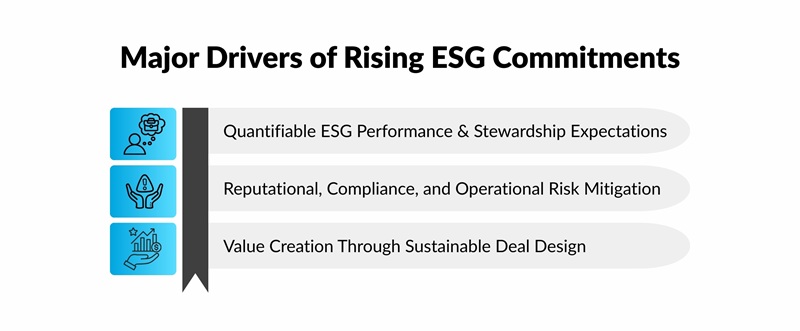
Major drivers behind rising commitments include:
-
Pension funds, insurers, and endowments are more and more demanding that ESG private equity funds should be able to tie the capital deployment to quantifiable sustainability performance, and a clear stewardship strategy. This requirement forces private funds to incorporate ESG gates and reporting during the initial stages.
-
Heightened awareness that weak ESG practices can expose companies to reputational setbacks, compliance issues, and operational strain that ultimately weigh on the long-term performance of a fund in its lifecycle has driven investors to consider board and executive congruence over ESG risks as part of core risk management.
-
Strong evidence that ESG-focused private-equity strategies can contribute to the creation of margin, retention of talent, and premium exits when sustainability is considered at the outset of the deal thesis has convinced additional sponsors to view ESG as value-creating as opposed to regulatory compliance.
How Private Equity Firms Integrate ESG Across the Deal Cycle
The ESG considerations of private-equity firms are included in all levels of the deal, which influences the decisions made during the screening dialogue to the ultimate exit strategy. Early rating evaluates sector exposure, carbon intensity, labor conditions, supply-chain resilience, and governance maturity, and thus transforms qualitative ratings into quantifiable criteria that drive investment appetite.
-
In origination and due diligence, ESG private-equity teams use customized questionnaires, management meetings, quick scans of operational data, and on-site inspections. Some of the findings trigger valuation changes, and others reveal operational opportunities that support the investment case.
-
Monitoring is extended in the ownership phase. ESG private-equity funds follow climate indicators, workforce metrics, community impact, and governance changes and create dashboards that develop as the business goes through its growth cycle.
-
During the pre-exit period, companies package documented ESG performance, which can include emissions cuts, increased safety performance, or better board governance. These facts will support ESG-driven private-equity plans in attracting purchasers who appreciate clear enhancement.
A general industry trend towards systematic ESG analysis highlights the importance of how investors approach sustainability as a fundamental investment prism and not a filter. The 2025 Asset Manager Sustainable Investment Practices Study by Callan indicates that 76 percent of firms have moved to incorporate ESG research into their investment platforms, compared to 77 percent in 2023.
Evaluate Your Private Equity Readiness
Identify gaps, sharpen your approach, and stay ahead.
Take Your Quiz Now!
Sustainability Screens and Impact Metrics That Shape Capital Deployment
The contemporary ESG-private-equity strategies rely on rigorous screening devices to identify the type of businesses that are worth long-term capital. Sector exposure, carbon intensity, labor practices, and board structure, as well as community impact, are all scrutinized by investors before proceeding beyond a preliminary analysis. Such filters are used to filter out high-risk targets and highlight businesses in which sustainability can be improved through measurement, as opposed to guessing.
The same expectation is placed on institutional allocators. Thematic allocations, quantitative scorecards, and scenario models are being incorporated into deal teams that include exclusion lists, positive tilts, and thematic allocations. A recent survey by Acuity Knowledge Partners reported that 73 percent of respondents had more than a quarter of their portfolios in sustainable investments, 92 percent used formal ESG risk identification processes, and 70 percent expected to align with UNPRI principles by 2025. This change forces ESG private-equity funds to report all the assumptions made by a rating or score.
The common impact metrics that are currently utilized to steer capital deployment are:
-
Emissions, energy consumption, and resource-efficiency indicators that are connected to specified reduction pathways and interim targets.
-
Workforce measures such as health and safety records, retention rates, inclusion metrics, and training hours reveal social resilience in the long term.
-
Governance indicators to track independent oversight, incentive alignment, and incident reporting to base responsible ESG-private-equity practices upon verifiable data.
Where ESG Creates Real Value for Portfolio Companies
Strategic ESG integration has gone beyond the simple reporting process to the performance leverage of portfolio companies. Sustainability efforts are integrated into value-creation strategies under ESG-private-equity ownership that aim at enhancing margins, reducing risks, and reputational resilience. Operating costs may be minimized through energy efficiency, minimization of waste, safer working environments and stricter governance, minimization of losses incurred during incidents, and creating less volatility in cash flows throughout the holding period. General partners in private markets. According to the Sustainability in Private Markets 2025 report by BCG, over the lifespan of an investment, private-equity partners report an EBITDA growth of 4 to 7 percent due to sustainability-linked initiatives.
-
Portfolio firms with sponsors of ESG-private-equity tend to achieve significant cost reductions and margin stability by improving their operations in terms of energy-efficiency improvements, waste-cutting programs, and improved safety measures.
-
Creation of value also arises whereby ESG-private-equity investment creates revenue advantages and better exit positioning: companies can win new business due to sustainability-oriented customers, join green procurement programs, and get a premium in exit deals as potential acquirers and sponsors start viewing strong ESG frameworks as strategic assets.
Challenges That Investors Must Address Without Slowing Progress
Investors who manage ESG requests in the private markets often face challenges that create friction but do not pay off. The demands to comply with various disclosure requirements may blur priorities, particularly where ESG private-equity funds are run across multiple jurisdictions with conflicting concepts of materiality. These discrepancies hamper the comparison of progress and deter the establishment of a definite direction for portfolio companies.
-
Reporting regularly exceeds the capacity of operations, and managers have to search for templates instead of driving significant resilience-boosting changes.
-
The process of governance argument among investment groups may drag out the decision-making process, especially when the environment and social concerns conflict with the traditional focus on returns.
The increasing demands of limited partners further complicate the concept of ESG-private-equity since the latter demand even higher specificity, whilst the former companies still optimize their measurement activities. These issues require discipline in order to ensure that momentum on sustainability build-up does not decline and that firms continue at a steady pace without straining their investment processes.
Conclusion
The wave behind ESG investing in private equity is not a fad, but it is reshaping the way companies structure their plans, act, and evaluate performance. The expectations are rising as ESG private equity funds are going beyond compliance in order to build performance and resilience-enhancing strategies. This development indicates that ESG private equity can direct capital to firms that effectively address risk, respond to stakeholder pressure, and create value thoughtfully to build a more definitive path to sustainable, long-term growth.