Introduction to Interim Controller Leadership
The month-end close keeps its schedule when a controller resigns. Bank reconciliations still need review, auditors still expect support, and lenders still wait for reports. Organizations in that position often turn to an interim controller, an experienced accounting leader who takes charge of the finance function for a limited period.
An interim financial controller carries the full responsibility of a permanent controller within a defined mandate and a fixed end date. The arrangement will ensure accuracy and continuity during recruitment, leave, or significant change. When the job comes up, decision makers who know what the role entails, what it should deliver, and how to hire it should be able to move swiftly.
Defining the Interim Financial Controller Against Related Roles
A controller oversees all accounting activity, supervises accountants and bookkeepers, builds internal controls, and monitors cash flow, usually reporting to the Chief Financial Officer(CFO) or president. In effect, the controller keeps and interprets the company’s financial record. Accountants record financial data. Controllers confirm that the data is accurate, timely, and consistent with company policy. CFOs concentrate on strategy and capital decisions.
An interim financial controller works on an interim basis from a couple of weeks to many months, either part-time or full-time, to take on the role of controller. The level of authority is dependent on the agreement. Some approval rights are associated with some appointments, others focus on review and recommendation.
Two neighboring options deserve separate mention. Outsourced controllers provide part-time or on-demand support on an ongoing basis, which suits companies that never need a full-time controller. Fractional CFOs concentrate on strategy and capital planning.
Each role covers a distinct need. Controllers verify the accuracy of the financial record, CFOs set strategy and capital direction, outsourced controllers provide ongoing part-time accounting support, fractional CFOs supply part-time strategic guidance, and an interim financial controller covers the controller role for a defined period.
Responsibilities and Deliverables During an Engagement
Daily work centers on a reliable close, supported by general ledger accuracy, account reconciliations, and consistent cutoff procedures. Management reporting, including variance commentary for department heads, translates ledger activity into information that operating leaders can use. Beyond that baseline, the interim controller covers several tangible deliverables.
-
Provides financial statements, budgets, and forecasts that meet Generally Accepted Accounting Principles (GAAP) and, where applicable, Securities and Exchange Commission (SEC) reporting requirements
-
Delivers Cash flow analysis and forecasting that supports liquidity decisions
-
Prepares for audits, including organized documentation for annual reviews and compliance checks
-
Tests internal controls and remediates gaps before auditor’s request evidence
-
Conducts workflow reviews to remove inefficiencies and automate routine tasks
-
Manages enterprise resource planning (ERP) or finance software transitions, covering data validation and staff training
Process improvement is given specific focus as an outside leader can benchmark current processes with those of other organizations. The accounts payable, accounts receivable, payroll and accounting team continue to be supervised. The interim controller also assists in the financial due diligence and integration of the two sets of records into one reporting system in the context of a deal.
Situations That Justify a Temporary Appointment
Leave and turnover create the most frequent need. An extended parental or medical leave, a retirement, a resignation, or a termination leaves the department without its senior accountant, and a temporary appointee gives the organization time to evaluate permanent candidates carefully. The appointee can assist with interviews, relieving other executives of this task.
-
Calendar pressures often prompt interim appointments. Year-end reporting and audit season strain even well-staffed teams, and an unexpected audit can arrive with little notice.
-
Transitions matter as well. Mergers, acquisitions, restructurings, and system overhauls call for integration skills that many teams exercise rarely.
-
Private equity ownership is a different case. There are times when newly acquired companies require better-reporting standards and more stringent controls, and an interim appointee can come on without lengthy recruitment. The owners have time to consider if the long-term design requires a full time controller, a CFO, or a different finance structure.
Consider a hypothetical lean company that acquires a competitor. It is not possible to run two sets of books on its single controller and the institutional knowledge is locked to one person, as it is unable to build consolidated reporting. The interim controller is responsible for consolidation and documents what had been in the minds of the people, and then passes a more clean structure to the permanent team.
Advantages, Engagement Models, and Cost Considerations
An experienced appointee needs little ramp-up time, keeps financial operations running through a leadership gap, and lowers regulatory risk through disciplined compliance. Coming from outside, the appointee can also question existing processes without the influence of internal politics.
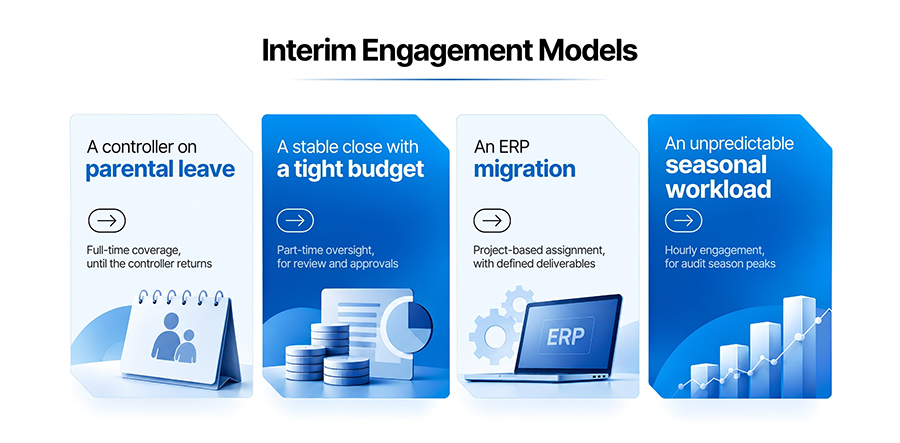
Lean teams carry a particular exposure, because one departure can remove institutional knowledge that was never written down. A temporary leader reduces that exposure by documenting processes and steadying the team during the permanent search. Matching the arrangement to the situation controls both flexibility and budget.
-
A controller on parental leave calls for full-time coverage until return.
-
A stable close with a tight budget suits part-time oversight for review and approvals.
-
An ERP migration fits a project-based assignment with defined deliverables.
-
An unpredictable seasonal workload pairs with an hourly engagement for audit season peaks.
Smaller companies gain further benefits. Systems and processes introduced during the engagement can often be maintained by the remaining team, whether that includes a CFO, a fractional CFO, or a staff accountant. Compared with a permanent hire, an interim engagement avoids recruiting fees and benefits obligations, although the daily rate is higher. Contract terms should state scope, deliverables, and notice periods.
Credentials and Vetting Standards for Candidates
Candidates typically hold a recognized accounting designation and have prior controller-level tenure.
Financial controls, accounting, and audit ranked first among the skills most requested for interim leaders and experts in the 2026 Skills Index from Heidrick & Struggles.
Technical depth covers US GAAP, SEC reporting for public companies or those preparing for an initial public offering (IPO), ERP systems, and industry-specific standards. Industry fluency shortens orientation, for example, familiarity with revenue recognition in software or inventory costing in manufacturing. Communication skills matter equally, since a temporary executive must earn the confidence of an existing team quickly. Experience across several organizations helps, since a candidate who has handled similar situations recognizes problems earlier. Documented results, such as shorter close cycles, resolved audit findings, and completed system cutovers, provide stronger evidence than a list of past titles. References from prior finance leaders or audit partners offer the most reliable view of how a candidate performs under deadline pressure. Screening should test claimed expertise directly through a technical conversation or work sample and confirm education and employment history through independent checks.
Hiring Timeline, Onboarding, and Handover
Time is of the essence when a job becomes available, and structure helps to avoid errors. Firstly, establish immediate needs and scope. There are specialized staffing firms that have a list of screened candidates, and the company’s audit firm or other service providers can also refer to experienced professionals. The quality and depth of the vetting varies from source to source and it is not uncommon to approach more than one. Interviews should be focused on similar scenarios, industry context and ERP experience. A template contract takes the time needed to negotiate, and even with time constraints, references and credentials should be called.
Preparations are ongoing until the first day. Long-term expectations (key performance indicators, or KPIs) must be committed to, in addition to short-term goals, like stabilizing reporting and closing out pending tasks. Access to systems and records must be organized ahead of time and there must be a named person for each system, with a named contact for the newcomer who should be met with the team at an early stage. Brief introductions and a concise explanation of the appointee’s mandate help to facilitate collaboration, even on a short-term basis. Confidentiality terms are important as controllers have financial information that they need to keep confidential.
The opening month is mostly diagnostic. The appointee reviews accounting policies, financial statements, the software stack, cash flow, budgets, and forecasts, then proposes the first improvements. A recurring weekly conversation with the CFO keeps priorities aligned.
Handover closes the engagement, and scheduling documentation and training sessions across the final weeks protects continuity better than a last-minute transfer. The appointee completes open projects, documents processes, trains staff on new procedures, and recommends ongoing practices. When a successor has been hired, the interim controller trains that person as well. System access granted to the appointee should be reviewed and removed at the end of the engagement to protect sensitive data. Some organizations extend the arrangement instead.
Conclusion
A short checklist helps decision makers evaluate an interim controller before signing an agreement. Each item reflects a point where engagements often succeed or stall.
-
Scope, authority, and engagement type confirmed in writing
-
Credentials, references, and background verified
-
Short-term goals and system access prepared before the first day
-
Documentation and training expectations set for the final weeks
-
Cost compared against a permanent hire for the same period
-
Exit and extension terms agreed in advance
-
Plan for the permanent role identified early
Aligning the engagement with the long-term finance structure, including the profile of the future permanent controller, gives the temporary investment lasting value.