Private equity firms are holding portfolio companies for longer periods than they did through most of the 2010s. Bain & Company’s Global Private Equity Report 2026 puts the global stock of unsold portfolio companies at roughly 32,000, valued near USD 3.8 trillion, with buyout assets exiting after about 7 years on average.
Each added year of ownership brings another set of quarterly valuations to document and a longer history for auditors and investors to review.
Private equity fund management software integrates investor onboarding, capital calls, distributions, fund accounting, compliance audit, and reporting into a single governed system. Platform attributes include audit readiness, investor confidence, and efficiency in quarterly reconciliation. The first choice has a lasting impact on operations since Changing platforms often involves significant operational and financial costs.
Fund managers, chief financial officers, and investor relations professionals each rely on distinct outputs from the same system, and each group judges the software’s purchase decision by separate measures of success. This guidance applies to firms of any size that are evaluating software for private equity operations.
Core Functions Across the Fund Lifecycle
Fund operations begin before the first close and continue until the final distribution. Software for private equity supports that span through several connected functions.
Investor onboarding includes digital subscription documents and accreditation attestations, along with identity checks that form part of Know Your Customer and Anti-Money Laundering screening. Investor relations records provide one set of records for each limited partner’s commitments, contacts, and communication. Fund drawdown and distribution processing creates notices, monitors wire, check or automated clearing house payments and updates capital accounts without re-entry. Fund accounting utilizes allocation rules, management fee logic and waterfall logic, which sets the order in which distributions are paid. Reporting generates statements and performance reports that are tailored to each investor type.
Undrawn commitments make the capital call function especially consequential. In the Private Equity International LP Perspectives 2026 Study, which Bain cites, 53 percent of limited partners said that earlier commitments not yet drawn down limited their capacity for new ones. Accurate tracking of called and uncalled capital informs fund pacing and investor dialogue. Delays or errors in notices affect liquidity planning for every investor in the fund.
Platform Categories and Their Distinct Roles
Platforms differ in the problem they were built to solve, and a mismatch between category and need produces the costly purchasing errors.
-
Investment record registers maintain commitments, capital calls, distributions, and valuations by effective date, with source documents linked to each entry.
-
Portfolio monitoring and analytics platforms collect operating data from portfolio companies, standardize it, and support benchmarking across funds.
-
Fund accounting and investor reporting suites combine ledger functions, allocation logic, and investor statements for administrators and managers whose reporting depends on accounting processes.
-
Front-office relationship tools manage deal sourcing, fundraising activity, and investment committee coordination.
A second distinction separates systems of record, which store and maintain authoritative fund and investment data, from systems of execution, which use that data to produce recurring work such as investor reports, board materials, and committee memos. Commitments, accounting entries, and portfolio company metrics sit in a system of record. Investor reports, board materials, and committee memos come from a system of execution that converts stored data into recurring work products. Many firms hold several systems of record and lack a governed layer that produces outputs from them.
Buyers can resolve the category question by naming the single workflow that carries the highest manual cost or risk and selecting the category that addresses it directly. Broader suites serve firms seeking consolidation, while specialized tools fit firms with one defined gap.
The platform category also determines how financial and investor data is captured, validated, and carried into downstream reports. That makes data integrity a direct test of whether the selected platform is suited to the firm’s reporting requirements.
Data Integrity and Reporting Accuracy
Consider a hypothetical fund that holds 20 portfolio companies across 4 investment vehicles. The general partner issues a quarterly valuation report, a drawdown notice arrives on a Tuesday, and a distribution follows 3 weeks later. If the platform records the valuation under the wrong effective date, the internal rate of return and distributions to paid-in capital figures for the period shift, and every downstream investor statement carries the error.
Accuracy in situations like this depends on four inputs.
-
Cash flow dates that support IRR (internal rate of return) and DPI (distributions to paid-in capital) calculations
-
Valuation effective dates aligned with the manager’s reporting period
-
Entity mapping from each investment to its legal vehicle and owner
-
Source documents linked to the record they support
Dashboards that refresh continuously improve visibility, yet private equity data arrives on a periodic cadence set by general partners, with quarterly valuations and intermittent notices between them. Software structures that data, flags missing statements and stale valuations, and shortens review time. Internal professionals still validate the figures before they reach an investor. Therefore, claims of real-time reporting should be verified by comparing the actual refresh frequency of each data source with its documented update schedule.
Capability Checklist for Shortlisting
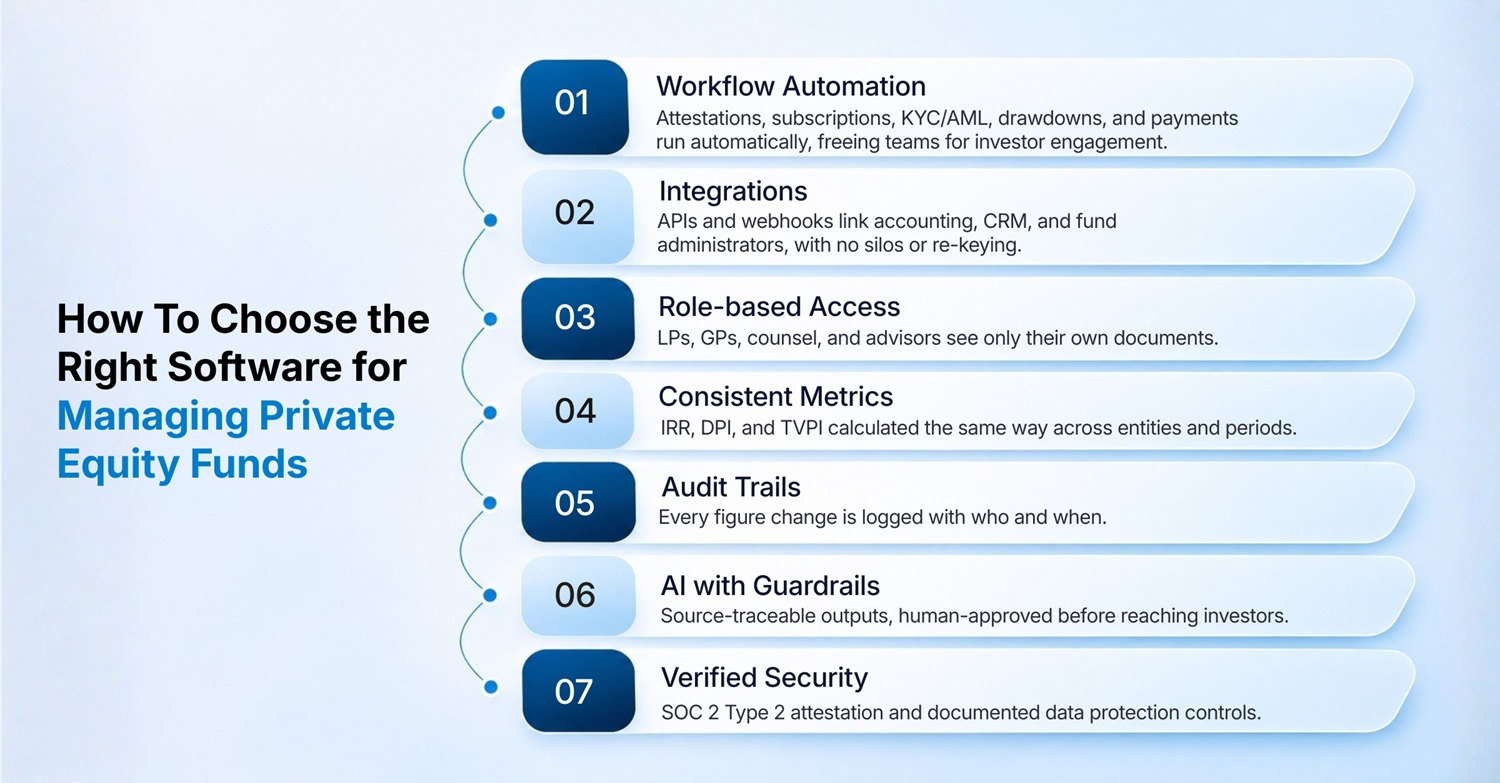
A structured checklist keeps the shortlist tied to capabilities that affect operations. The following items apply to most firms.
-
Workflow automation for investor attestations, digital subscriptions, KYC and AML checks, drawdown notices, and payments, which automates workflows, allowing relationship teams to focus on investor engagement
-
Integration through APIs and webhooks with accounting systems, customer relationship management tools, and fund administrators, which prevents data silos and re-keying
-
Role-based document access that separates what limited partners, general partners, counsel, and advisors can view
-
Consistent calculation of IRR, DPI, and total value to paid-in capital across entities and reporting periods
-
Audit trails and validation rules that record who changed a figure and when
-
Artificial intelligence features with source traceability and human approval before any output reaches an investor
-
Independent security attestations such as SOC 2 Type 2 and documented data protection controls
Firms should rank these items by operational impact before reviewing any demonstration. A fund with many investors may weigh automation and access controls most, while a firm with complex structures may weigh calculation consistency and audit trails. Weighting the checklist in advance limits the influence of presentation quality on the final choice.
Implementation Planning, Ownership, and Total Cost
Implementation follows a consistent sequence across most firms. Teams inventory the data held in documents, spreadsheets, and administrator portals. They then build the fund and investment list with commitments and structures, map entities and ownership across trusts, partnerships, and holding vehicles, and decide how much historical data to import. Quality assurance validates cash flows, valuations, and mappings before a first reporting cycle tests outputs and exposes gaps.
The depth of historical data strongly affects timelines. A firm importing 5 years of cash flows across a dozen entities should expect a longer reconciliation phase than a firm starting with current-year records only, and the vendor’s estimate should reflect that difference.
Ownership requires explicit assignment. Typically, a finance or operations lead owns the reporting process and data structure, analysts validate cash flows and valuations, and external administrators supply source data without owning the outputs.
Pricing models vary and include flat-rate, assets-under-management-based, and per-user structures. Smaller firms may reduce initial cost with a usage-linked model, yet total cost of ownership should include customization, implementation, and training fees. The value gained includes saved hours, fewer errors, and improved investor interactions.
Scalability, Usability, and Vendor Support
Investor demand supports planning for capacity ahead of need. A January 2026, McKinsey survey of 300 global limited partners found that about 70 percent planned to maintain or increase their private equity allocations during 2026.
Private equity fund management software selected for one fund may need to serve several vehicles, currencies, and jurisdictions within a few years. Scalability assessment should confirm whether the platform covers end-to-end workflows or isolated tasks, whether workflows can be customized, and whether administrators can set up a new fund without paid professional services.
Usability determines adoption speed for investors, fund managers, and legal teams. Live demonstrations and trial periods show the number of steps to perform on a routine task, and the interface’s suitability for occasional users, like limited partners. The same should be applied to support quality, from response times to resources, to named contacts.
Reference conversations with firms of similar size and fund count supply evidence that marketing materials cannot. Questions about onboarding timelines, the handling of support escalations, and the frequency of product updates produce answers that can be compared across vendors.
Evaluation Protocol Before Contract Signature
A structured test plan converts the earlier criteria into evidence. The selection committee can run these steps in a sandbox environment using real fund data.
-
Load one fund with actual cash flow dates and run a full quarterly cycle, then compare outputs with the administrator’s figures.
-
Enter a valuation with a prior-period effective date and confirm that IRR, DPI, and total value to paid-in capital adjust correctly.
-
Trace 1 fund drawdown from notice to payment to updated capital account, confirming that every document remains linked.
-
Open the audit trail for a corrected record and confirm that the original value, the change, and the user are all visible.
-
Request sample exports and documented API access for the existing accounting and relationship management systems.
-
Run a user permission change, such as removing an advisor’s access mid-quarter, and verify that the change takes effect immediately.
-
Review contract terms for data export at termination and escalation steps when a source statement is missing.
Each test can receive a pass or fail result in a scorecard, and any failed test should carry a written remediation date from the vendor before contract signature. A firm that completes this protocol holds documented evidence of how the platform handles its own entity structures and reporting calendar, which a vendor demonstration alone cannot supply.